Drones and artificial intelligence could help industries better monitor air quality and make more informed environmental decisions, with University of Southern Queensland (UniSQ) researchers exploring the technology's potential through a new collaboration in Indonesia.
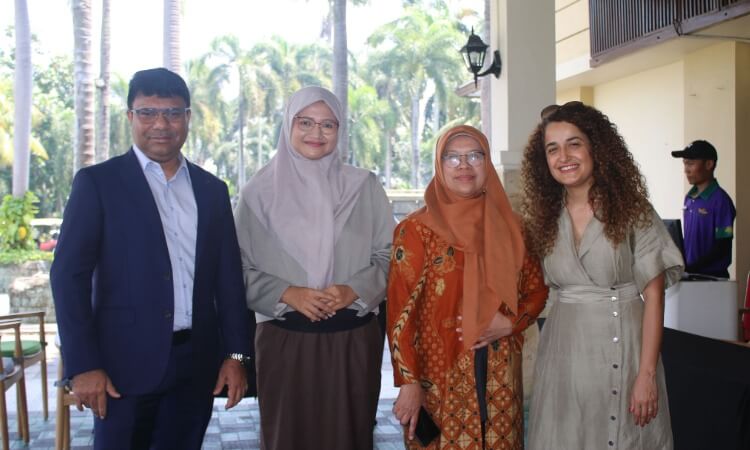
Associate Professor Syed Shams and Professor Zahra Gharineiat are working with Indonesian universities, industry and technology partners to investigate the potential of drone-based air-quality monitoring at Jababeka Industrial Estate, one of Indonesia’s largest industrial areas.
More than 20 industrial tenants participated in a workshop at Jababeka, where researchers demonstrated how drones could collect environmental information across different locations and heights.
Associate Professor Shams said emerging technologies could complement existing environmental monitoring systems by providing more detailed data to support sustainability management and reporting.
“Drones, environmental sensors, AI and data analytics may provide new ways to generate and analyse environmental information,” he said.
The project also included a workshop at President University, engaging more than 100 students and faculty members, including accounting and business students.
The sessions explored the growing importance of environmental information for business decision-making, corporate accountability and sustainability reporting as Indonesia moves towards sustainability disclosure standards, including PSPK 1 and PSPK 2.
“Businesses increasingly need reliable information and appropriate systems to understand, manage and communicate sustainability and climate-related risks and opportunities,” Associate Professor Shams said.
The initiative brought together environmental technology, sustainability reporting and education, while strengthening connections between UniSQ, President University, PT Jababeka Infrastruktur, ENMINTECH International and Indonesian industry.
“International collaboration is at the heart of the initiative, with air pollution, climate change and corporate sustainability presenting shared challenges for Australia and Indonesia,” Associate Professor Shams said.
“While the two countries approach these issues from different economic, regulatory, geographic and industrial contexts, these differences create valuable opportunities for mutual learning.”
Professor Gharineiat said the collaboration also offered valuable opportunities for Australia and Indonesia to learn from each other’s approaches to environmental management and sustainability.
“Indonesia has extensive experience managing rapid industrialisation and the environmental challenges associated with major industrial and urban areas, while Australia brings complementary expertise in environmental research, sustainability, technology and corporate reporting,” she said.
“At the same time, Australian researchers can learn from Indonesia’s industrial context, environmental challenges and rapidly developing sustainability-reporting landscape.”
Supported by the Australian Government through the Department of Foreign Affairs and Trade and the Australia–Indonesia Institute, the project aims to build on these connections through longer-term research and collaboration.
“Future research could investigate longer-term air-quality monitoring by combining drone observations with existing ground-based monitoring technologies and using AI to analyse environmental datasets and identify patterns,” Professor Gharineiat said.
The researchers also hope to develop joint research projects, industry case studies, student projects, researcher exchanges and further Australia–Indonesia grant applications.
They hope the initial collaboration will develop into a lasting partnership between universities, students, researchers and industry, while contributing to improved environmental management and sustainability reporting.