From perfect GPA to fungal diets: Georgia’s journey into conservation
7 min read
23 Sep 2026
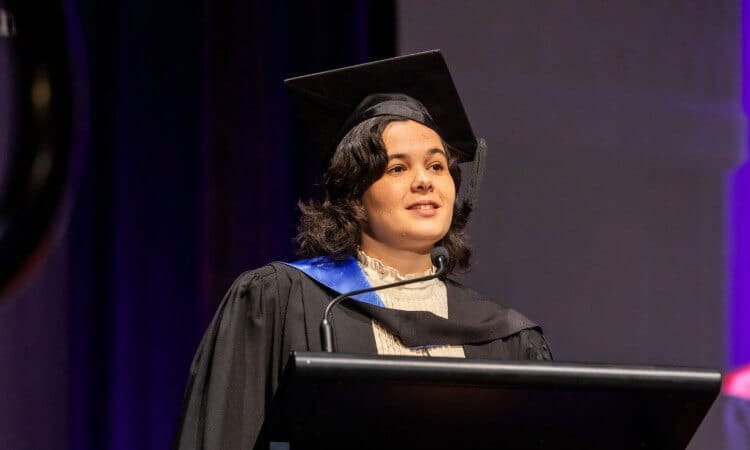
With a surname like Fox, it is perhaps no surprise that Georgia Fox grew up as an “animal kid” with a passion for wildlife and ecology.
That passion has taken Georgia from university study and fieldwork into a career protecting Australia’s environment. Earlier this year, she graduated from the University of Southern Queensland (UniSQ) with a Bachelor of Science (Honours), achieving a perfect GPA of 7.0 and receiving a University Medal in recognition of her academic excellence. She was also selected as the valedictorian for her graduation ceremony.
Georgia’s honours research explored the fungal diets of small mammals in southeast Queensland, investigating the role fungi may play in the diets of native species including bush rats, melomys and antechinus.
Now working as a Biosecurity Officer with the Department of Agriculture, Fisheries and Forestry, Georgia has also been named an Australian Council of Environmental Deans and Directors (ACEDD) Scholar for 2025.
We spoke with Georgia about her university experience, her research, and her passion for protecting Australia’s unique environment.
Congratulations on being named an Australian Council of Environmental Deans and Directors (ACEDD) Scholar for 2025. What does this recognition mean to you, and what opportunities do you hope it will create?
I was honoured to be nominated for this award by my amazing supervisors from UniSQ. It means a lot to me for my work to be recognised in this way, and I hope it will create more opportunities for me to progress my career in the conservation industry as well as opportunities for further study in the future.
You graduated earlier this year with a perfect GPA of 7.0 and received a University Medal. Looking back, what are you most proud of from your time at UniSQ?
I’m really proud of the relationships I built with fellow students as well as with academic staff. Nothing can be accomplished without the support of the people around you. But I’m also proud of the work I did as part of my honours project. I was able to propose a research topic I was passionate about and was lucky enough to receive support from my supervisors to develop and pursue the project from start to finish. It was a big undertaking and I learned a lot, not just about the research topic but about my own capacity, resilience and determination, and I’m very proud of the results I received as well as the finished thesis.
Achieving a perfect GPA is no small feat. What do you think was the key to your academic success?
The key to success for me was following my interests. I often looked forward to hitting the books at the end of the day because the material I was learning was always exciting to me. Even when taking courses that weren’t 100 per cent aligned with what I eventually wanted to do, I recognised where there were opportunities to apply what I was learning to my future career or to my future studies. The flexibility provided by UniSQ was also a massive help. My coursework provided opportunities for me to explore areas that I wanted to and to tailor assessment pieces to topics I genuinely wanted to learn more about. In general, I’m someone who loves to learn but being able to align my degree with what I was passionate about meant that there was never a dull moment.
What first sparked your interest in ecology and wildlife science, and why did you decide to pursue honours research in this field?
It’s tough to pinpoint where my interest started. I was an animal kid and I spent a lot of time outdoors from a young age. I decided to pursue ecology as I got older and particularly honours research because I was interested in the processes that help ecosystems function. As I learned more about the field I found out how much we still must learn as a scientific community and I wanted to play a part in contributing to research that might eventually help to protect our ecosystems. Plus getting to see our amazing native wildlife in their natural environment is an experience like no other.
Your honours research explored the fungal diets of small mammals such as rodents and antechinus. Can you explain your project and its findings in simple terms?
The project looked at the fungal diets of small mammals and the methods used to study them. My research focused on four small mammal species in southeast Queensland, where very little previous research on this topic had been conducted, and found that all four species consumed fungi. This was the first recorded instance of fungal consumption, known as mycophagy, for two of the species. Interestingly, all four species consumed a similar diversity of fungi. This was particularly notable because the bush rat (Rattus fuscipes) is already well known for eating fungi, while much less was known about the diets of the other species. The findings suggest these other small mammals – the fawn-footed melomys (Melomys cervinipes) and the two Antechinus species (Antechinus subtropicus and Antechinus mysticus) – may consume fungi more regularly than previously thought.
For many people, studying animal scat under a microscope might sound unusual. What was the most surprising or interesting thing you discovered during the research process?
I was particularly interested to see the diversity of fungi in the diets of the Antechinus species as they are generally considered carnivorous. The fungal diets of the broader dasyurid group should be examined further as the nutritional implications could be quite interesting. However, the most surprising findings were probably the differences in the fungal taxa detected between the two methods (microscopy and eDNA). While common taxa were detected across the two methods, each method also identified taxa not detected using the other, so I hope the methods can be further refined into a standard protocol for a variety of research groups to use. The detection of entomopathogenic (insect pathogens) fungi using eDNA was also of particular interest and I hope further research can be conducted to determine if mammals play a role in the secondary dispersal of these fungi.
Why is understanding the relationship between small mammals and fungi important for Australian ecosystems?
It’s important to look at the fungi in the diets of our small native mammals as they play a role in dispersing fungal spores through ecosystems. This is particularly relevant for mycorrhizal fungal species which form symbiotic relationships with a variety of plant species. However, it is also relevant for pathogenic and saprophytic fungal species as they also play important roles in ecosystem functioning. We still have a lot to learn about the fungal kingdom, especially in an Australian context, and understanding these relationships between organisms will lead to more informed ecosystem management and conservation.
What advice would you give to students considering studying environmental science, ecology or wildlife science at university, and why would you recommend UniSQ?
To go for it! University study, particularly in a field that you are truly interested in, is so rewarding and fulfilling. And to echo a piece of advice from one of my professors, get out into the bush as often as possible, every weekend if you can. Not only will you learn more about the environment, plants, wildlife and fungi you are studying, but when things get tough, it’s a great reminder of why you wanted to dedicate yourself to study in the first place. I would also genuinely recommend UniSQ to anyone considering studying wildlife or environmental science. The programs are well designed, and I have been genuinely in awe of what I have been able to learn during my studies. The teaching staff are passionate and inspiring, there are so many opportunities for students, and you can make the courses work for you, no matter what your goals are.
You currently work as a Biosecurity Officer with the Department of Agriculture, Fisheries and Forestry. Can you tell us about your role and what you enjoy most about the work?
I’m currently a team leader for the plant inspections team in Brisbane. We inspect plant material coming into the country to ensure it’s free from biosecurity risk material such as insects, weed seeds or potential pathogens. There are so many things I enjoy about the work and I feel like I learn something new every day, but what I enjoy most is getting to work with amazing, supportive people who are dedicated to protecting Australia’s unique environment. And when I go bushwalking on the weekends, I get to feel like what I do during the week makes a difference.
Related news

1 min read
7 Aug 2026
5 min read
27 Jul 2026
3 min read
22 Jul 2026