“Don’t feel like you have to cut off one branch to let the other grow.”
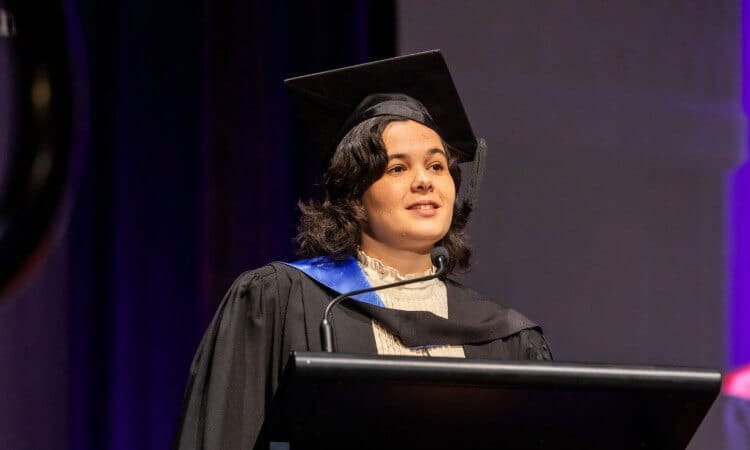
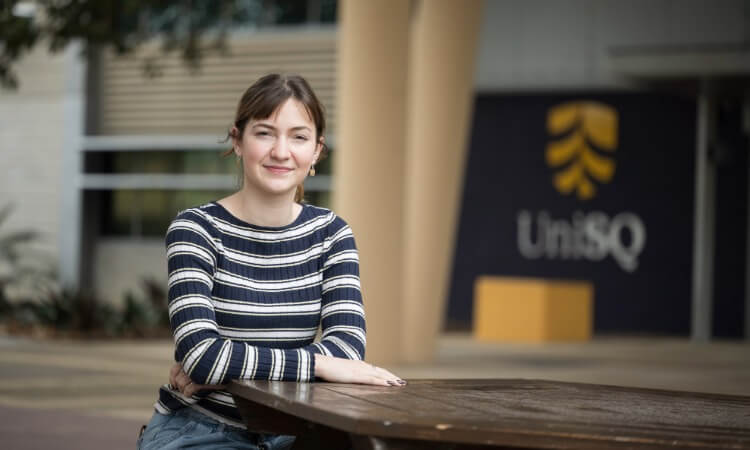
For May Reardon, staring up at the stars and getting lost in a good story have always gone hand in hand.
After starting out studying physics and astronomy, May quickly realised she didn’t want to choose between the part of her that loved science and the part that loved to write.
So, she made the move to the University of Southern Queensland (UniSQ) where she could pursue both astronomy and creative writing – a combination that lets her “scratch the itches on both sides” of her brain.
Now, May dreams of becoming a sci-fi author, inspiring more young women to follow their curiosity into STEM and one day returning to study exoplanetary research.
We caught up with May about her childhood fascination with space that started it all, the stories that fuel her imagination, and why she believes you really can have the best of both worlds.
Can you tell us a little bit about yourself and why you decided to study astronomy and creative writing at UniSQ?
I transferred to UniSQ after completing around one and a half years of a Bachelor of Physics, minoring in Astronomy, at another university. I began feeling deeply unsatisfied in my learning after completing all my electives, which were always writing courses, and most of the smaller astronomy programs at the time. So, as one does, had a giant existential crisis about my future, realising that if I limited myself to only numbers for the rest of my life, I would be very unhappy. I knew UniSQ had an extremely strong astronomy program and decided to transfer and expand my major to satisfy that creative itch I have.
Astronomy is often described as the science of discovery, while creative writing is the art of storytelling. How do those two passions come together for you?
I spent a lot of my time growing up staring at the night sky. Naturally, I became a very inquisitive person – due to the copious number of hours I spent in my own head, staring at the vastness of space. Having a creative outlet helped foster this curiosity, because my brain would start filling the gaps of anything Google couldn’t answer. Now, the two passions come together through my love of the sci-fi genre – whether that’s reading or watching Doctor Who. In future, I want these passions to coalesce into a successful book trilogy that is based on hard sci-fi, and maybe discover a few planets of my own on the side.
Are there any influential figures who have inspired you or influenced the way you think about science or storytelling?
Brian Cox had a show on ABC3 that I attribute to my origin story, called Wonders of the Solar System. This sparked my obsession with space when I was in middle school, which was then cemented by Amie Kaufman and Jay Kristoff’s novel Illuminae, Doctor Who, and my dad’s addiction to Star Wars.
What has been the most rewarding part of studying these two disciplines together so far?
I finally feel like I’m able to scratch the itches on both sides of my brain. I didn’t want to have to pick one path and stick with it all my life. It’s also quite rewarding being able to push myself in such different ways. I will say, I think my favourite thing now is being able to understand the more difficult parts of science behind different space-related books or movies. Project Hail Mary was a recent fun one. It’s quite a proud feeling when you’re able to explain mind-bending physics to your friends and watch their eyes fill with a tiny bit of wonder.
How do you hope to combine science and storytelling in your future career?
After graduation, I hope to establish myself as an author and build a reputable platform, before eventually returning to study later in life to focus on exoplanetary research. I want to predominantly write sci-fi stories to hopefully inspire other young women to follow this path.
What would you say to someone who thinks they must choose between science and the arts?
Don’t feel like you have to cut off one branch to let the other grow. Sometimes it might be hard to balance, but these skills don’t have to grow at equal paces. Sylvia Plath’s famous fig tree metaphor has gained some traction in recent years, and I resonated with it while deciding on whether to transfer or not. I realised, though, we’re not limited to one thing all our lives, so you don’t have to give up on one goal to achieve the other. But at the same time, you can always take a break from one to focus on the other. Learning is not linear.
Is there anything else you’d like to add?
Next time you’re at a bookstore, I highly recommend picking up Illuminae!