UniSQ research into wearable sensors attracts $1.3 million in ARC funding
2 min read
16 Sep 2026
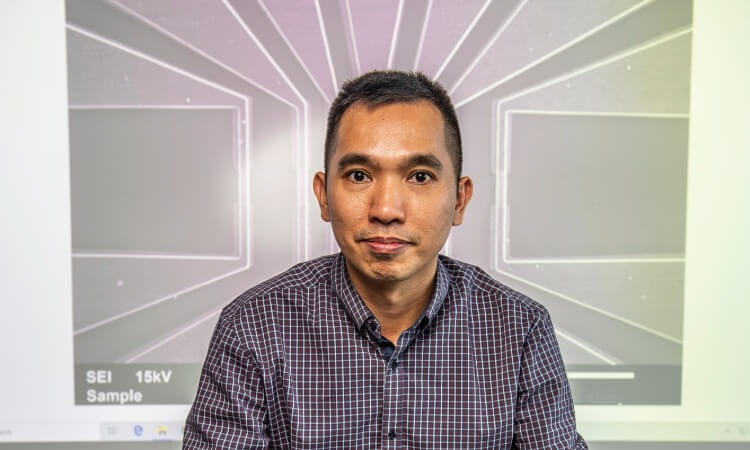
Wearable sensors that can reliably monitor workers in some of Australia’s harshest environments are the focus of a new University of Southern Queensland (UniSQ) research project led by Associate Professor Toan Dinh.
Many existing wearable sensors struggle in conditions such as high temperatures, heavy sweating, moisture and corrosion, limiting their effectiveness in demanding workplaces.
Associate Professor Dinh’s research aims to tackle these challenges and develop a more effective way to monitor workers in industries including mining, construction, manufacturing and emergency services.
“Wearable sensors can provide valuable information about a person’s health, movement and physical workload, but many existing sensors are designed for relatively controlled environments,” Associate Professor Dinh said.
“This is a major challenge for Australian workers in industries such as mining, construction, manufacturing and emergency services.”
Associate Professor Dinh has been awarded $1.3 million through the Australian Research Council’s (ARC) Future Fellowship scheme to advance research that will combine semiconductor structures with reinforced-fibre composites to create a new platform for robust wearable sensing.
The sensors could eventually be integrated into clothing, protective equipment or flexible patches worn on the body, continuously monitoring a worker’s physical condition and potentially identifying heat stress, fatigue or increasing physical strain before these conditions become serious.
“By enabling earlier intervention, this technology could improve workplace safety and provide new ways to understand how workers respond to demanding environments,” Associate Professor Dinh said.
The research will bring together semiconductor structures, which provide sophisticated electrical and sensing capabilities, with reinforced-fibre composites that offer strength, flexibility and durability.
“Rather than simply protecting a sensor from harsh conditions, we aim to engineer the semiconductor and fibre composite together so that the material itself contributes to sensing and mechanical resilience,” Associate Professor Dinh said.
The project builds on his existing research into semiconductor devices, MEMS/NEMS, advanced materials and wearable sensors, including work supported through the Queensland Government’s Quantum 2032 Challenge, which is exploring quantum technologies and wearable sensors to help prevent injuries in young athletes.
The ARC Future Fellowship will provide Associate Professor Dinh with the time and resources to build his research program and develop new ideas, while bringing together researchers with complementary expertise at UniSQ and internationally.
The research will also strengthen Australia’s research capability and future prosperity by developing new technologies and highly skilled researchers.
Related news
3 min read
26 Oct 2026
3 min read
23 Oct 2026
5 min read
22 Oct 2026