By Kiara Jones
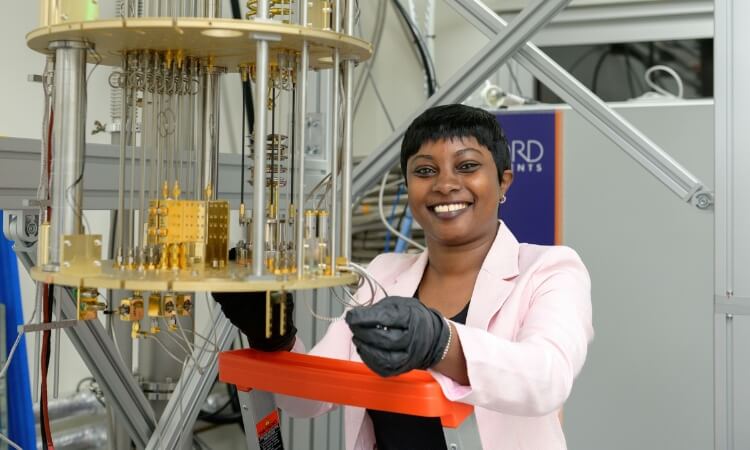
Cooling quantum devices to temperatures colder than outer space might sound like science fiction, but for University of Southern Queensland (UniSQ) PhD student Dorothy Mringie, it is part of her everyday research.
Originally from Kenya, Dorothy is now working in UniSQ’s Quantum Cryo Lab (QC Labs) at the Springfield campus, where she is researching ways to improve the reliability of quantum computers.
Supported by the Queensland Government’s Quantum and Advanced Technologies Global Talent Attraction PhD scholarship, Dorothy’s work focuses on Josephson junctions – tiny components that help create qubits, the fundamental building blocks of quantum computing.
Her journey into the world of quantum research is driven by curiosity, opportunity and a passion to inspire others from diverse backgrounds to see themselves in science.
We recently spoke with Dorothy about her journey into quantum research, moving to Australia, and the future of the technology.
How long have you lived in Australia – what was your first impression when you arrived?
I arrived in Australia in December 2025, and my first impression was how beautiful and green everything was. It was summer, so I also loved the open water spaces where people could go and cool off – it felt very free and relaxed. What really stood out to me was how open and supportive the environment felt. I remember thinking this is a place where I could truly grow into the kind of researcher I want to become. The access to research facilities and the encouragement to explore ideas have really made an impact on me.
What has been the biggest difference between Kenya and Australia?
For me, the biggest difference has been how real and accessible research feels. In Kenya, the curiosity and interest are there, but opportunities to explore fields like quantum in a practical way are still developing. In Queensland, I’ve been able to step into that space, working in labs, using advanced equipment, and collaborating with others in the field. It has changed my perspective, because I’m no longer just learning about it, I’m actually part of it.
Have you found any similarities between Kenyan and Australian culture?
Oh yes! People are genuinely warm in both places. I’ve found that whether in Kenya or Australia, people are open and willing to connect, especially in academic spaces, which made settling in much easier than I expected. I’ve also noticed a strong shared agricultural culture. Fresh food is a big part of everyday life in Kenya, and I’ve seen the same appreciation here in Australia for fresh, locally grown produce. I was especially excited about the avocados – I didn’t expect to find so many that were so fresh here. Nilifurahia sana (I was so happy). It feels like a reminder of nyumbani (home).
What inspired you to pursue a PhD, and why did you choose UniSQ?
My interest in physics started from simple curiosity, but during my Master’s in optics, I worked on how light interacts with atoms, and that’s when quantum became real for me. I knew I wanted to go deeper – or maybe smaller, since it’s quantum. That’s what inspired me to pursue a PhD. I wanted to contribute, not just learn. UniSQ stood out because of its growing work in quantum technologies and being awarded the Quantum and Advanced Technologies Global Talent Attraction PhD scholarship, funded by the Queensland Government, made it possible for me to take that step.
Can you explain your research and the problems you’re trying to solve?
I work on very small components used to build quantum computers, called Josephson junctions. They’re what help create qubits, which are the basic units of quantum information. The challenge is that even the smallest imperfections during fabrication can affect how well they work. My research focuses on understanding those differences and improving how these devices are made, so they become more reliable.
What work are you doing in the new QC Labs at Springfield, and how does access to this lab support your research?
The cryogenic quantum lab is where we cool our devices – Josephson junctions – down to about 20 millikelvin, which is extremely cold, much colder than outer space. We go to these temperatures because quantum behaviour becomes much more stable, allowing us to properly test how these devices perform and how reliable they are. Having access to this lab is essential for my research because it allows me to test these devices under the conditions they’re actually designed to operate in.
What message would you share with others considering a similar path?
This has been a very personal journey. Coming from Kenya into quantum research in Queensland has shown me what’s possible with the right support and opportunities. As a woman in this field, it also means a lot to be part of a growing and diverse community in quantum technologies. I hope my journey can encourage others from different backgrounds to see that they can be part of this space too.