Some historical events are so catastrophic they resist comprehension. And yet they compel us to try to understand them, again and again.
Chernobyl is one of them.
On April 26, 1986, at 1:23am, Reactor No. 4 at the Chernobyl Nuclear Power Plant in Soviet Ukraine exploded, releasing a cloud of radioactive material that drifted across Europe and contaminated land inhabited by around five million people in Ukraine, Belarus and Russia.
Although it is impossible to calculate the total number of deaths attributable to the explosion and its after-effects, 31 people were killed immediately or died due to Acute Radiation Syndrome in the following months, while deaths in the years since could be as high as 10,000. Around 116,000 people were evacuated from the 30-kilometre exclusion zone in the two weeks following the accident.
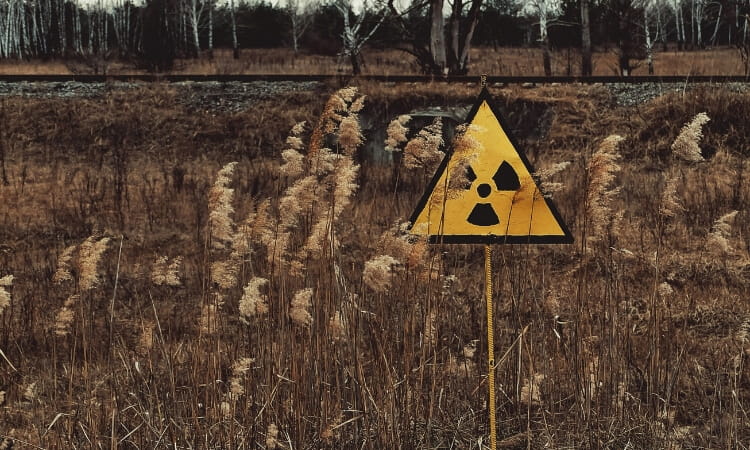
As the radioactive dust settled on forests and rivers, poisoning water and food supplies, flora and fauna, it also embedded itself, indelibly, in the cultural imagination.
Forty years on, we are still working out what happened – and what it means.
An explosion that never ends
Countless books, documentaries and television dramas, as well as artworks, plays, video games and comics, grapple with the causes of the disaster and its aftermath. They seek to make visible what was invisible at the time: not just radiation and its effects on the human body, but the Soviet government’s attempts to cover up the accident.
This week, Ukrainian writer and illustrator Yevgenia Nayberg published her graphic memoir, Chernobyl, Life, and Other Disasters – a künstlerroman (artist’s novel) charting her coming-of-age as an artist under Chernobyl’s long shadow. Born and raised in Kyiv, Nayberg was 11 years old and preparing for art school when she heard on the radio that “one of the nuclear reactors was damaged”, but “the situation [was] under control”.
In a recent interview, Nayberg reflected that “the most difficult part” of writing the book was “trying to forget that I know the future”.
In her memoir, she insists on the accuracy of her memories and the truth of her lived experience, set in stark contrast to the secrecy and obfuscation that marked the Soviet government’s response.
“They are just repeating the same thing over and over again,” the young Nayberg declares. “That means they’re hiding something.” Her parents and grandparents arrive at the same conclusion.
“They used to pretend that they trusted the news,” she observes. “Not anymore.”
In his 2006 essay Turning Point at Chernobyl, former president of the USSR – and the last Soviet leader – Mikhail Gorbachev argued “the nuclear meltdown at Chernobyl […] was perhaps the real cause of the collapse of the Soviet Union five years later”. “There was the era before the disaster,” Gorbachev wrote, “and there is the very different era that has followed.”
Yet it was not the meltdown itself that led to “the collapse”, but what it revealed: the extent to which the Soviet government would lie to its own people and to the world. Gorbachev said nothing to the rest of the world until a full week later, when he assured a concerned global audience “the worst is behind us”. At the same time, he denounced the “mountain of lies” purportedly being spread by Western media.
It is hardly surprising, then, that a preoccupation with truth and deception drives almost every cultural retelling of the disaster. In the collective memory, Chernobyl is not an isolated event confined to the past, but a contagion that continues to mutate and spread.
The several books written about the disaster include Nobel Prize-winner Svetlana Alexievich’s Chernobyl Prayer: Voices from Chernobyl (1997) and Grigori Medvedev’s eyewitness account, Chernobyl Notebook (1987), as well as more recent detailed studies by historians Serhii Plokhy (Chernobyl: History of a Tragedy, 2018), and Adam Higginbotham (Midnight in Chernobyl, 2019).
While these books differ in theme, focus, and narrative style, they all ultimately grapple with a crisis of representation: how do we express through language what defies comprehension?
Plokhy, a Harvard professor who grew up downstream from the destroyed reactor and whose thyroid was damaged by radiation exposure, concludes his haunting history of the disaster with a warning: “The world has already been overwhelmed by one Chernobyl and one exclusion zone. It cannot afford any more.”
‘This is how radioactivity looks’
The first documentary about Chernobyl was filmed three days after the explosion.
Directed by Soviet filmmaker Vladimir Shevchenko, Chernobyl: Chronicle of Difficult Weeks (1986) documents the cleanup operations undertaken by Ukrainian workers and volunteers, many of whom would later die from the high levels of radiation they were exposed to.
The 54-minute film, the product of three months of continuous shooting, opens with an aerial shot of the destroyed reactor before cutting to grainy footage of a televised speech by Gorbachev on May 14, 1986. “We have been struck by disaster,” he announces, “we have been confronted by danger: atomic energy which has become uncontrollable”.
The documentary deflects the threat to an unknown enemy, clinging to the language of war. The exclusion zone is the frontline, the liquidators are “soldiers performing a great feat” and the deserters who “abandoned their comrades” are “cowards” whose names would be made public “regardless of rank or position”. “Deserters were not executed,” the film assures, “but the people’s contempt would serve as eternal punishment.”
This vain attempt to reaffirm the Soviet myth of heroism – the faultless ability to overcome catastrophe – reveals the state’s attempt to absorb Chernobyl into its own mythology: to make it, in the end, a story about what the Soviet people could endure.
But what we witness, from a safe distance and with the vantage of hindsight, is something far more sinister: the radiation saturating the camera and, by extension, the hand holding it. The on-screen flashes of light, white and crackling, were initially mistaken by Shevchenko and his team for a problem with the film. “We thought this film was defective,” he explains. “But we were mistaken. This is how radioactivity looks.”
Shevchenko himself died from acute radiation sickness less than a year later. His film, suppressed by Soviet authorities and released only posthumously, is sometimes described as the most dangerous film in the world.
For a story so many were determined to silence, there is a surprising wealth of footage. As the recent documentary Chernobyl: The Lost Tapes (2022) explains, “the Soviets […] documented everything believing they would show the world a heroic victory.” In time, the truth would assert itself.
Chernobyl’s children
One year after the incident, in 1987, The Bell of Chernobyl, “an unusually frank work that plainly suggests the Soviets were wholly unprepared for the disaster”, mysteriously failed to arrive in time for its scheduled screening at the Berlin International Film Festival.
The festival’s official journal noted “there are forces in the Soviet Union – and they are not new ones – who would prefer not to have the film screened”.
These nuclear documentaries, according to film studies scholar Helen Hughes, reveal the difficult art of filming a toxic ghost – a danger that cannot be seen, heard or touched, yet whose presence can be “felt in the teeth”.
Nikolaus Geyrhalter’s Pripyat (1996), made ten years after the disaster, marked one of the first occasions when an international film crew was granted access into the 30-kilometre exclusion zone. Shot entirely in black and white, the camera lingers on stunning irradiated landscapes – frozen forests and overgrown streets – depicting a world that is the same, yet different.
At its centre, however, are the human stories of those who live and work there. Like the lab technician who, upon returning to her former flat in Pripyat, learns her possessions have been stolen by looters. And the safety officer who works at the power plant: “I keep this power plant running,” he jokes. “I am one of the guarantees that nothing will happen.”
When the film was first screened in 1996, audiences were surprised to learn Chernobyl was still operating.
In the 2000s, popular documentaries about the disaster turned to the human cost of Chernobyl, including the so-called generations of Chernobyl children whose lives were stolen from them.
Of these, none proved more confronting than Chernobyl Heart (2003), a 40-minute documentary short directed by Maryann De Leo. It follows Irish humanitarian Adi Roche and her team of aid workers as they travel through Belarus and Ukraine, visiting thyroid cancer wards, overcrowded children’s homes and maternity hospitals where, according to one doctor, only 15-20% of babies are born healthy.
In the Novinki Mental Asylum north of Minsk, we meet Julia, a girl born with her brain outside her skull. Another child, aged four, is the size of a four-month-old. Some children with cerebral palsy spend their entire lives in cots.
“I suppose I’m relieved to see she’s still alive,” Roche says of one child, “but I’m not sure that’s the best thing for her.” Gesturing at another group of children, she says, “we don’t know what’s wrong with them.”
The film, which won the 2003 Academy Award for Best Documentary Short, was criticised for its explicit depiction of children’s damaged and deformed bodies. At the time, the suffering of Chernobyl’s children was typically rendered symbolically – through a broken toy or an abandoned doll – rather than shown directly.
Often, the children themselves were not told what was wrong with them. In one quietly devastating scene, a teenage girl – born three weeks before the explosion – tells the camera she has “some problems” in her neck. As we leave her, the attending doctor reveals she has thyroid cancer. “Of course we don’t tell the children,” he says.
“It was the hardest film I’ve ever made,” De Leo later said. During filming, she was hospitalised for radiation poisoning.
The experience did not deter her. Five years later, her follow-up film, White Horse (2008), shadowed a Ukrainian man as he returned home to Pripyat for the first time in 20 years.
Secrets, lies and untold stories
The most influential retelling is undoubtedly Craig Mazin’s five-part HBO miniseries, Chernobyl (2019), which garnered 19 Emmy nominations and inspired a companion podcast.
The series stars Jared Harris as senior nuclear scientist Valery Legasov: the man tasked with containing the disaster, who took his own life on April 27, 1988 – exactly two years and one day after the explosion.
Reconstructing the timeline of events (before, during and after the explosion), the series is sharply critical of the power wielded by the Soviet government, its nuclear industry and their affiliated forces. It raises enduring questions about nuclear safety, especially emergency preparedness and response, and risk communication.
The series draws in part from Alexievich’s acclaimed book, Chernobyl Prayer, a polyphony of poetic first-person testimonies collected over a ten-year period with more than 500 eyewitnesses, including doctors, soldiers, scientists, helicopter pilots, miners, former party bureaucrats, and ordinary citizens.
As its title suggests, the book gives voice to the individuals who lived through the disaster. Compared to the series, it is a more nuanced and reflective account of the slow forms of violence that persisted long after the reactor was sealed and the cameras left.
One young father who volunteered as a liquidator recalls:
We got home. I took everything off, all the stuff I’d been wearing there, and threw the lot down the rubbish chute. I gave the cap to my little son as a present. He kept asking for it. He wore it non-stop. Two years later, he was diagnosed with a brain tumour. You can write the rest yourself. I don’t want to say any more.
Both Chernobyl Prayer and Chernobyl portray the processes that rob people of their human status – forcing them to exist beyond the threshold of human experience. The radioactive particles both inhabit them and haunt them: “Chernobyl, for those who were there, did not end in Chernobyl. They were returning not from war, but almost from another world.”
For this reason, Chernobyl is not just a story of horror. It is also, for instance, a love story: between Vasily, a firefighter exposed to a lethal dose of radiation, and his pregnant wife, Lyudmila, instructed to protect their unborn child from his “scorched” body.
In Alexievich’s book, the nurses tell her, “You mustn’t forget this isn’t your husband, it isn’t the man you love. It’s a highly contaminated radioactive object.” But Lyudmila remains by Vasily’s side – changing his sheets, wiping him down, at one point removing “pieces of lung and lumps of his liver […] coming up through his mouth.”
Alexievich writes that since Chernobyl:
Love has changed. And death, too. Everything has changed, except us.
Like Yevgenia Nayberg, Ukrainian cultural historian Maria Tumarkin was 11 when Chernobyl happened. She turns to Alexievich when it feels impossible to answer the question: “How does a society witness itself? Witness itself failing at its most fundamental duty?”
The most enduring texts about Chernobyl move beyond the disaster as event and attend to it as warning – not sensationalist, but willing to listen to what it still tells us: about power, about the “cost of lies” (as the HBO series puts it), and about the slow violence of catastrophe that does not announce itself – and does not end.
Some of what Chernobyl cost us cannot be measured. It can only be carried. This is why Chernobyl remains a story worth telling. And why it will keep being told, again and again.
The article has been republished from The Conversation under the Creative Commons license. Read the original article.