UniSQ researcher awarded $1.1 million for 3D-printed construction research
2 min read
02 Jun 2026
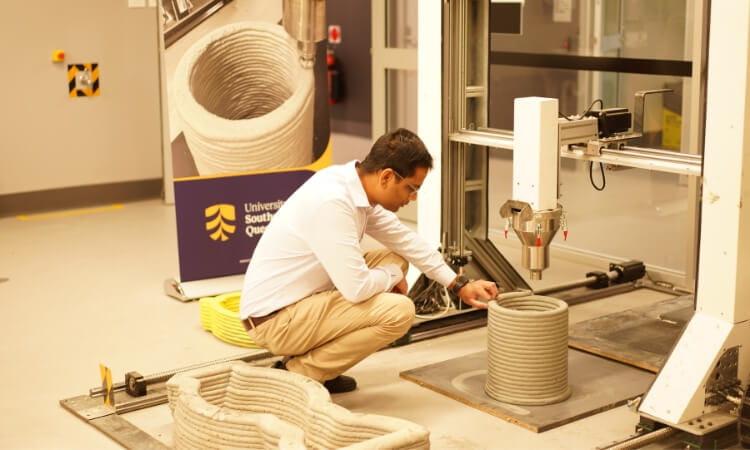
A University of Southern Queensland (UniSQ) researcher is using advanced 3D-printed concrete technology to address major challenges in Australia and Vietnam, including urban noise pollution in dense cities and the reuse of agricultural waste.
Dr Saya Ramakrishnan has received almost $1.1 million in competitive grant funding across two projects focused on improving environmental sustainability, housing liveability and community wellbeing.
The research will explore how automated 3D-printed construction and advanced concrete technologies can repurpose waste materials, improve energy efficiency and support healthier living environments, highlighting the growing role of smart construction in addressing complex international challenges.
One project, funded through the Australian Research Council’s Linkage Projects 2025 Round 2 scheme with nearly $600,000 in awarded funding, will address noise pollution in Australia’s increasingly dense urban environments.
“We will develop innovative 3D-printed housing designs that combine topology optimisation and porous, biochar-enhanced concrete to improve both structural performance and reduce noise transfer in homes and apartment buildings,” Dr Ramakrishnan said.
“The project will support faster, more cost-effective construction, reduce waste and deliver higher performing buildings, while ultimately improving the quality of life for residents.”
The second project, supported through the Aus4Innovation Partnership Grants Round 5 program, received almost $500,000 to investigate how agricultural waste in Vietnam can be transformed into sustainable building materials using high-tech pyrolysis and automated 3D-printed concrete construction.
“In Vietnam, agricultural waste is commonly burnt in open fields after harvest, contributing to poor air quality, environmental damage and significant financial loss,” Dr Ramakrishnan said.
“The project will examine how these waste products can instead be converted into biochar – a highly versatile porous material produced through pyrolysis – and incorporated into 3D-printed concrete for housing and urban infrastructure with superior thermal performance and energy efficiency.”
The Australian project is supported by Swinburne University of Technology, 3D Builders, Pyrocal and Organica Engineering. The research team includes Dr Ramakrishnan and Professor Allan Manalo from UniSQ, and Professor Xiaodong Huang from Swinburne University of Technology.
The Vietnam project is being delivered in partnership with Ho Chi Minh City University of Technology, with support from Pyrocal, Luyten3D and Organica Engineering. The research team includes Dr Ramakrishnan and Professor Manalo, and Dr Son Nguyen Khanh from Ho Chi Minh City University of Technology.
Together, these projects position UniSQ at the forefront of innovative, sustainable construction approaches for the next generation of housing and infrastructure.
UniSQ researchers will also contribute to externally led projects funded through the Australian Research Council’s Linkage Projects 2025 Round 2. These include Dr Sadegh Balotf’s contribution to the University of Tasmania project ‘Identification and deployment of resistance to powdery scab of potato’, while Professor Lei Ge and Professor Ashok Nanjundan will contribute to The University of Queensland projects ‘From efficient hydrogen peroxide electrolyser to industrial generator’ and ‘Plastic Waste to High-Value Graphene Composites’ respectively.
Find out more about Research at UniSQ.
Related news
5 min read
22 Oct 2026
6 min read
19 Oct 2026
2 min read
16 Sep 2026