Cambodia classroom teaches future teachers lessons for life
3 min read
29 Sep 2026
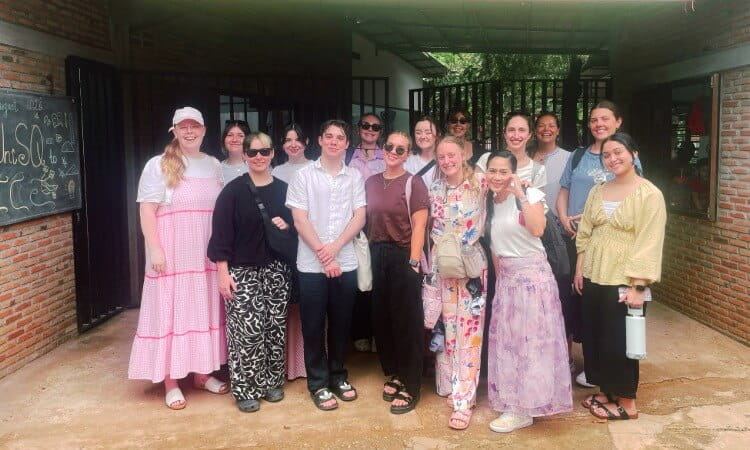
Fourteen University of Southern Queensland (UniSQ) preservice teachers have returned from Cambodia with new perspectives on education, culture and the kind of teachers they hope to become.
Over two weeks, the UniSQ students swapped their familiar classrooms for schools and communities around Siem Reap as part of the EduTREAK Cambodia Study Abroad program.
They taught alongside Cambodian educators, explored village life, made hundreds of eco-bricks for a local housing project and visited communities on the edge of Tonlé Sap Lake.
But perhaps their biggest lesson was learning to become comfortable with being uncomfortable.
From their first days in Cambodia, the students were encouraged to look beyond what was familiar and consider how history, culture, family and community shape the lives of learners.
A visit to the Siem Reap Killing Field Memorial confronted the group with Cambodia’s recent history and prompted reflection on how its effects continue through communities and generations.
That learning continued at TREAK Community Centre, where the students were introduced to Cambodian cultural and social norms before beginning their work with local teachers and children.
The students then stepped beyond the school gates to see the community through the eyes of the children they would teach.
Walking through Treak Village, they saw homes built on stilts to withstand wet-season flooding, family-run shops operating from the front of houses and rice fields that offered a glimpse into the physical work behind one of Cambodia’s staple crops.
The experience helped the group understand that meaningful cultural learning could not be separated from the everyday lives of the students and families around them.
That lesson became considerably more physical when the preservice teachers traded the classroom for a construction site.
Working in hot and humid conditions, the group helped produce 400 eco-bricks in one morning for a new home for a local family.
The bricks incorporate plastic waste collected from local streets, which is purchased from community members before being processed and mixed with sand, cement and water.
By the end of the morning, clothes were dirty, muscles were aching and the group had helped create enough bricks to make a significant contribution to the house.
Back at TREAK Community School, another kind of learning was taking place.
Across the two weeks, the UniSQ students worked alongside Cambodian teachers in classrooms from kindergarten to middle primary.
The students watched their Cambodian counterparts turn limited resources into creative lessons.
For the UniSQ students, it challenged assumptions about what good teaching requires.
Plans changed. Resources were limited. Communication did not always go smoothly. Those moments became some of the most valuable.
Students learned to adapt, collaborate and find solutions when their carefully made plans did not survive contact with an unfamiliar classroom.
The commitment of the Cambodian teachers also made a lasting impression.
That spirit of community was again apparent when the group travelled to Kampong Khleang on the edge of Tonlé Sap Lake.
Moving through the community by boat, the students saw families living and working around the water and reflected on the different opportunities available to children depending on where they are born.
But amid the challenges, it was the strength of the community that stayed with them.
The visit also provided a tangible example of what sustained investment in education can achieve.
A school visited by the previous year’s EduTREAK group while it was still under construction was now operating, with students attending classes and sewing programs running.
After two weeks, the UniSQ group returned to Australia and the familiar rhythms of lectures, tutorials and assignments.
But the experience had shifted their understanding of what it means to teach.
They returned with greater confidence working with diverse learners and a deeper appreciation of culturally responsive teaching.
They had also seen that effective education is not defined by technology, plentiful resources or perfectly prepared lessons, but can be built through creativity, relationships and a commitment to helping students succeed.
For the future teachers, Cambodia also broadened the responsibility they saw for themselves.
Their role would not simply be to prepare students for academic success or employment, but to foster curiosity, empathy, respect for difference and an understanding of an increasingly interconnected world.
Related news

5 min read
7 Oct 2026
2 min read
25 Sep 2026
3 min read
21 Sep 2026