From Roma to rural medicine: Chloe’s ambition to give back
7 min read
27 Aug 2026
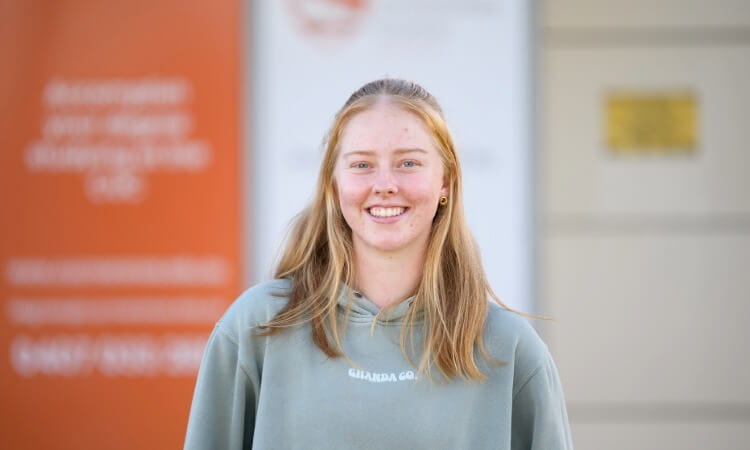
Growing up in Roma, University of Southern Queensland (UniSQ) Medicine Pathway student Chloe Davis knows what it means to live hours from healthcare many Australians take for granted.
Now, through UniSQ’s Medicine Pathway, she is turning that experience into an ambition to become a doctor in rural Australia.
Supported by scholarships, the Country Universities Centre (CUC) Maranoa and rural immersion experiences across Western Queensland, Chloe is gaining firsthand insight into regional healthcare while preparing for a career serving communities like her own.
Can you tell us about your journey to study the Medicine Pathway at UniSQ? What inspired you to pursue medicine, and why was UniSQ the right fit for you?
I started considering medicine in Grade 9. Studying Agricultural Science and Biology sparked my interest, but I wasn’t all that interested in the anatomy of a cow; I was more interested in learning about people and building human connections. From there, I spent my free time researching medicine: what it is, what a doctor does and how to become one. By Grade 11, I was set on studying medicine.I participated in programs such as Aspire to Health throughout my later years of high school, which gave me great insight into what day-to-day life looked like for doctors, medical students, and other allied health professionals. I did the UCAT in the middle of assignment time in Year 12, which was definitely a challenge as I was the only person I knew in the town doing it and didn’t have any internal help. I was able to reach out to Helen Nolan through the CUC Maranoa, and she gave me plenty of resources that really helped me through that stressful time.
I knew UniSQ was the right fit for me because my degree feels like it was specifically designed for everything I want. The aim of my pathway is to immerse medical students in regional and remote Australia in the hope that we will serve these disadvantaged communities. That aligns with my goal of becoming a doctor in rural Australia and serving a community where resources are extremely lacking.
Growing up in Roma, how has your community shaped who you are today? In what ways has your regional upbringing influenced your aspirations to study medicine?
My community has shaped me into the person I am today, whether through sport, academics or socialising. Roma is definitely a sporting town. Throughout school I played touch, netball, volleyball, cross-country, soccer and more. Realistically, if I wasn’t at my after-school job, I was playing sport. The great part about growing up in a town like Roma is that we got to play against friends and other community members of all ages. It was a great way to have a laugh at the end of a day, but it also allowed me to make such great connections throughout my community. Events like musicals, fairs and races were also fantastic ways in which I learnt that my town shows up for one another. I got to show up for others too, creating bonds that are lifelong. I was also part of a program called Rural Youth Ambassadors, where students from across rural Southern Queensland came together to advocate for equality in rural education. Although this experience highlighted the gap in my education, I became really interested in how this translated across to the medical field. I recognised the large gap in medical care in Roma and realised that smaller, more remote towns would have even less access to basic medical care than I did.
Many students from regional areas face unique challenges when pursuing higher education. What has your experience been like studying at UniSQ, and how have support services such as the CUC helped you succeed?
Due to UniSQ’s close relationship with our school and town, I was very aware of UniSQ and many of the Head Start and scholarship programs that were on offer. This ended up being great when moving to Toowoomba, as I knew that if I needed help throughout the process, I could contact one of the many support staff and services.
Within the first month of starting at UniSQ, our course coordinator organised a meet-and-mingle with the cohort that started the previous year. This was one of the greatest opportunities to happen straight away. We met students who had been through what we were going through less than 12 months earlier and were able to lean on them as mentors and friends. Our cohorts are both small, with only 15–20 students each year, so this made me feel at home. UniSQ’s scholarships have also been instrumental in my ability to succeed and continue through the past three years. I received the Vice-Chancellor’s Scholarship, which made life so much easier. I didn’t have to stress too much about bills because I knew I had that support throughout my whole degree. Additionally, I received the Residential Scholarship because I lived more than four hours from the University. The CUC has been the place I go when I need to just focus on my studies, and I always know that if I need any support, I can just walk down the hall. The setup of the CUC makes studying and completing assessments so much easier, and it is a relief to have such a helpful resource 10 minutes from home.
Looking back on your time at UniSQ so far, what moments or experiences have had the biggest impact on you?
Recently, I travelled Western Queensland with my cohort for a Rural Immersion Week. We visited Roma, St George, Dalby, Stanthorpe and Toowoomba. This experience was truly eye-opening about what my life would look like in both a medical and a social setting. It allowed me to understand the difference in lifestyle and health outcomes for disadvantaged people and how the lack of access to resources can really impact them. It had such a significant impact on me because I could see the real-life implications of limited medical resources in rural and regional Queensland. It reinforced how much I want to help these disadvantaged communities. I think this experience was crucial to my development as a Medicine student because it captured both the good and the bad of living in the towns we visited. The positive underlying theme, though, was that at the end of the day, the community is there to support one another. Although we were shown some extreme disadvantages in regional towns, we were also shown that we have the opportunity to create change and that the future rests at our fingertips. It’s up to us to decide what we want to do. This was one of the most inspiring weeks I think I will experience, and I cannot wait to use the lessons I have learned in the near future.
When you think about your future as a doctor, what kind of impact do you hope to have?
Giving back to my community and similar communities is my end goal. I wouldn’t be where I am today without the people who pushed me forward and got me here, and the only way I know how to do that is by making the greatest impact on those who need it most. Whether that is being a local GP and helping families overcome and recover from illness, or being a doctor for the RFDS and providing a specialised service for rural communities who don’t have access to simple resources without having to drive for hours, I want to make a difference. I know what it is like to go without a basic health service. I know what it is like to have to wait weeks for something as simple as a visit to the GP, and I know how difficult it is to have to drive four to six hours to see a specialist or even just to pick up a moon boot because the hospital didn’t have any available. If I can help people struggling with these problems and make their hard days even a little bit better, I have done what I aimed to do.
What would you say to another student from a regional community who dreams of studying medicine or another university degree but isn’t sure they’re capable or whether it’s possible?
You miss every opportunity you don’t take. There was never a single moment in my own journey where I felt completely capable or ready because medicine is hard, degrees are hard, but they’re meant to be. Being from a regional community teaches you resilience, perseverance and how to keep going when it gets tough. These strengths are invaluable.
So why let fear and doubt stand in your way? Take the chance.
Learn more about UniSQ’s Bachelor of Medical Science (Medicine Pathway).
Related news
8 min read
27 Oct 2026
4 min read
23 Oct 2026
3 min read
23 Oct 2026