First Nations health and education leader receives UniSQ’s highest alumni honour
3 min read
10 Nov 2026
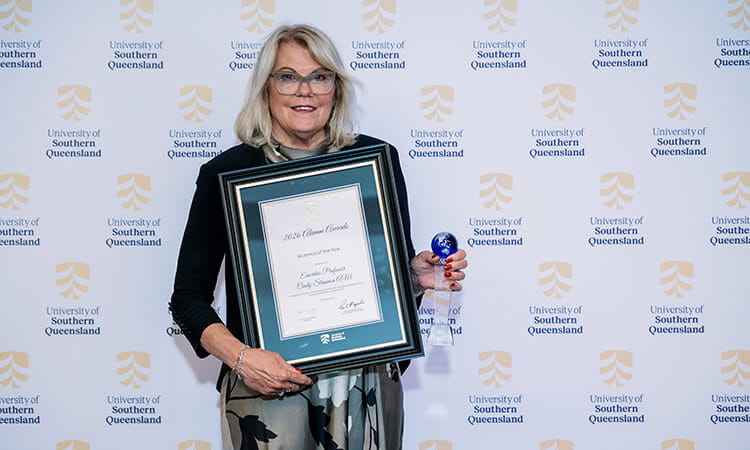
One of Australia’s most respected authorities in Indigenous health and education, Emeritus Professor Cindy Shannon AM has been recognised for her outstanding leadership and contribution to First Nations communities, receiving the University of Southern Queensland’s (UniSQ) highest alumni honour.
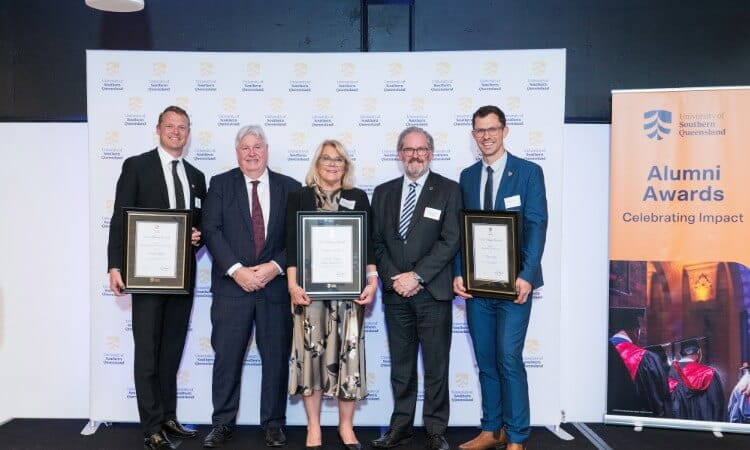
Emeritus Professor Shannon, a proud Ngugi woman and descendant of the Quandamooka people, was named the 2026 UniSQ Alumnus of the Year at the University’s Alumni Awards in Toowoomba. She also received the inaugural Alumnus Award for First Nations Excellence.
The awards celebrate the outstanding achievements of UniSQ graduates who have made a meaningful impact in their careers, industries and communities.
Emeritus Professor Shannon said she was honoured to receive the recognition, while acknowledging the people who had supported her throughout her career.
“I may be the person who gets the recognition, but there’s a whole team of people behind me who are equally deserving of it,” she said.
Her career has spanned Indigenous health, education, research and public policy, with a focus on improving outcomes for Aboriginal and Torres Strait Islander people and communities.
Her connection to UniSQ began with a Graduate Diploma in Education (Tertiary) from the Darling Downs Institute of Advanced Education in 1988, followed by a Master of Business Administration from UniSQ in 1993.
She went on to lead the development and implementation of Australia’s first degree-level program for Aboriginal and Torres Strait Islander health workers, helping create new pathways into the health workforce.
As Pro-Vice-Chancellor (Indigenous Engagement) at The University of Queensland from 2011 to 2017, she also served as Director of its Poche Centre for Indigenous Health and played a key role in supporting the establishment of the Institute for Urban Indigenous Health in south-east Queensland. She completed her academic career as Deputy Vice-Chancellor (Indigenous Diversity and Inclusion) at Griffith University in 2024.
Her contribution to Indigenous health and education policy has extended to state and national levels, including serving on the National Health and Medical Research Council from 2005 to 2012 and as a current member of the Board of the Australian Research Council.
She currently chairs the Gold Coast Health Board and formerly chaired the Sexual Health Ministerial Advisory Committee, the Brisbane South Primary Health Network and the Queensland Aboriginal and Torres Strait Islander Foundation, where she is now the Co-Patron. She and is also an Emeritus Professor at both The University of Queensland and Griffith University.
Emeritus Professor Shannon said lasting improvements in First Nations health required communities to be empowered to identify their own needs and lead solutions.
“It’s not a case of bureaucracies and other big organisations saying we’ve got the solutions. It’s about empowering communities to have those solutions,” she said.
Introduced in 2026, the Alumnus Award for First Nations Excellence recognises First Nations graduates who demonstrate exceptional leadership in their chosen field and make a powerful difference to their communities by strengthening cultural identity, improving social and economic outcomes, and creating positive change for First Nations people.
Reflecting on her connection to UniSQ, Emeritus Professor Shannon said her studies had played an important role in shaping her career.
“UniSQ was a great experience for me. It was the foundation that built my confidence and my ability to believe in myself and be a leader,” she said.
Related news

4 min read
2 Nov 2026

3 min read
30 Oct 2026
2 min read
30 Oct 2026