Building the communities of the future
6 min read
08 Oct 2026
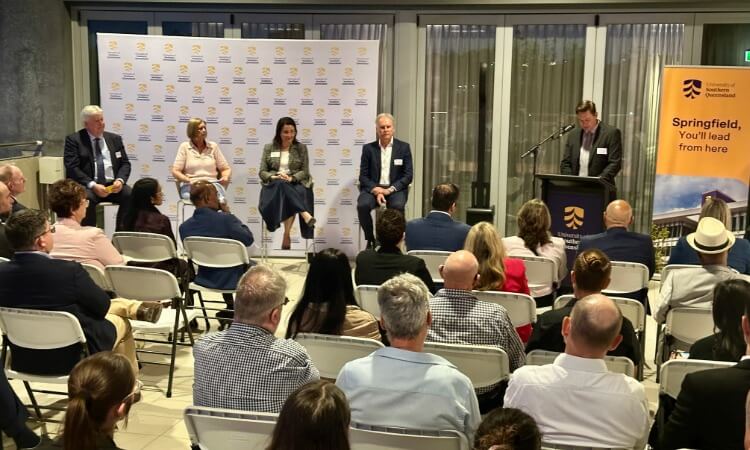
More than 30 years ago, Greater Springfield was an ambitious idea on the outskirts of Brisbane.
Today, tens of thousands of people call it home, with a university, hospital, schools, businesses and major sporting facilities forming part of a city that continues to grow.
But with that growth comes a bigger question: what does it take to build a community where people genuinely want to live, work and build their future?
That question brought together leaders shaping Greater Springfield for the University of Southern Queensland’s (UniSQ) latest Thought Leadership Series event, Building Australia’s Future Communities.
Held at UniSQ Springfield on Wednesday (7 October), the discussion used one of Australia’s largest master-planned communities as a living case study for the challenges facing fast-growing communities across the country.
And while roads, rail, hospitals and housing featured prominently, the conversation went much further – to local jobs, education, mental health and wellbeing, artificial intelligence, workforce shortages and the importance of bringing communities along as they change.
The panel brought together UniSQ Vice-Chancellor Professor Paul Mazerolle, Springfield City Group Deputy Chairman Bob Sharpless, Mater Hospitals Springfield General Manager Suzanne Hawksley and State Member for Jordan Charis Mullen MP, with UniSQ alumnus and Future Forgeworks Managing Director Rohan Richardson expertly moderating the discussion.
Few people have witnessed that transformation more closely than Springfield City Group Chairman and Founder Maha Sinnathamby AM, who opened the evening by returning to the question that helped start it all.
“When we began planning Springfield City more than three decades ago, we asked ourselves a fundamental question: ‘What does it take to build a community where people can live better lives?’” Mr Sinnathamby said.
The answer, he said, was built around three pillars – health, education and technology.
More than three decades later, Mr Sinnathamby believes the ambition should be greater still: for Springfield to become “Australia’s benchmark future city” – recognised for preventive healthcare, educational excellence, high-value employment and a safe, connected and prosperous community.
That vision provided the starting point for a discussion less about what Springfield has become, and more about what it – and communities like it across Australia – need to become next.
Ms Mullen said governments had an important role in continuing to invest in transport, health, schools and other essential infrastructure, but argued that creating more high-value jobs locally was equally important.
“There is always a risk that an area like Greater Springfield just becomes dormitory suburbs to Brisbane,” she said.
“We still have too many people who leave the area to go to those high-value jobs in Brisbane, on the Gold Coast or maybe in Logan.
“For us, it’s about: how do we bring those big industries here?”
But Ms Mullen said successful communities also required investment beyond roads, rail and buildings.
“Greater Springfield, like any other community, is not a glossy marketing brochure. It is a really complex community. It has complex needs and real issues,” she said.
She highlighted what she described as “soft infrastructure” – including mental health and support for young people and seniors – as increasingly important as the community grows.
For Ms Hawksley, planning for growth also means rethinking how healthcare is delivered.
She said major institutions needed to be “embedded within the community, not just sitting within it”, working with government, education providers and residents to anticipate future needs.
“It really is about designing healthcare that can be delivered outside the hospital walls and partnering with the community, education and government to do that,” Ms Hawksley said.
That could include greater use of hospital-in-the-home services, remote patient monitoring, allied health and other models designed to keep people healthy and reduce unnecessary hospitalisation.
Professor Mazerolle said universities had a similarly broad responsibility to the communities they served.
“We need to be a partner, a collaborator and a catalyst,” he said.
As UniSQ Springfield marks its 20th anniversary, Professor Mazerolle said the University needed to continue evolving alongside the rapidly growing region – from ensuring its degrees meet future workforce needs to expanding opportunities for upskilling and reskilling, research, innovation and entrepreneurship.
“We need to have no fences around the University, metaphorically,” Professor Mazerolle said.
“We have to be open, listening and learning, but also planning together.
“What kinds of programs will we need in the future so this community can keep thriving?”
He also outlined plans for an AI on the Go initiative, aimed at helping schools and small businesses better understand and use artificial intelligence, while stressing the importance of preparing graduates for workplaces being reshaped by the technology.
“We have to make sure students studying today and graduating tomorrow are AI-ready,” Professor Mazerolle said.
Mr Sharpless said the success of fast-growing communities ultimately depended on organisations accepting responsibility for the places they helped create.
“If we’re creating this community, then we have a level of responsibility to make sure it’s a good one,” he said.
“If you want to lift the standards, you’ve got to be prepared to play the long game. And it can’t simply be about maximising profit.”
He said collaboration was most effective when organisations stopped approaching challenges from opposing positions.
“If you want to solve any problem, you have to put everyone on the same side of the table,” Mr Sharpless said.
“You have to identify what the problem is and get everyone on the same side of the table wanting to solve it.”
That theme carried through the discussion, including questions from the audience about mental health, wellbeing and how communities could strengthen connections between organisations and residents.
Ms Mullen said collaboration did not always need to be complicated.
“I spend a lot of my time connecting people together,” she said.
“People say knowledge is power, and sometimes people think that by withholding information and knowledge, you have the power.
“I actually think the reverse. The more you share that knowledge, the more powerful you are – and the more powerful our community becomes.”
Asked to nominate one priority communities such as Greater Springfield needed to get right looking towards 2050, the panellists offered different but complementary answers.
Mr Sharpless nominated the timely delivery of infrastructure; Ms Mullen highlighted creating more local jobs so people could spend less time commuting and more time in their community; and Ms Hawksley chose education.
The discussion was particularly timely as UniSQ celebrates 20 years at Springfield, where the campus has grown alongside a community transformed since the University first opened its doors in 2006.
Reflecting on the partnership between the University and Springfield City, Mr Sinnathamby said the next decade presented an opportunity to deepen that collaboration.
“The combined efforts of Mater Hospital Springfield, Springfield City Group and the University of Southern Queensland can create something truly extraordinary: a model for how universities, healthcare providers and city builders work together to improve the health, wellbeing and quality of life of an entire community,” he said.
The Building Australia’s Future Communities event formed part of the UniSQ Thought Leadership Series, which brings together voices from academia, industry and the community to explore significant issues, ideas and opportunities shaping the future.
For Greater Springfield – and fast-growing communities across Australia – the message from the evening was clear: growth alone does not build a successful community.
It takes a long-term vision, sustained investment and organisations willing to work together to create places where people can live, learn, work and build their futures.
Related news

1 min read
7 Aug 2026
2 min read
29 Jun 2026
2 min read
22 Jun 2026
Tags