Sharne Neill's mission to protect Australia's rarest wombat
5 min read
22 Oct 2026
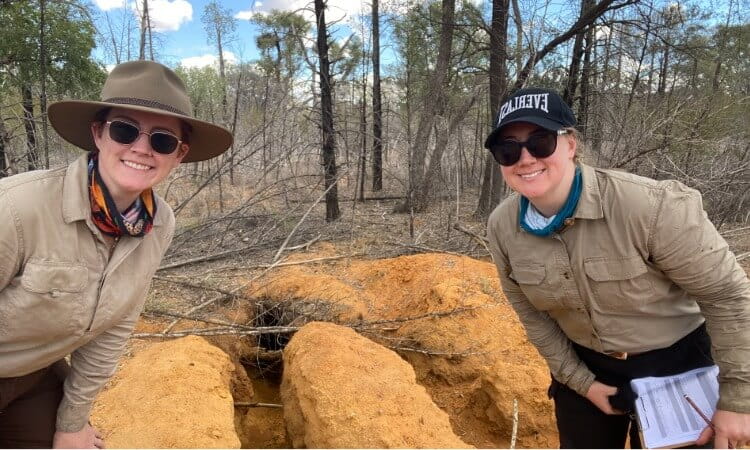
For University of Southern Queensland (UniSQ) PhD candidate Sharne Neill, a lifelong interest in wildlife has grown into a commitment to protecting one of Australia’s most endangered mammals.
With World Wombat Day taking place on 22 October, Sharne’s research is helping shed light on the northern hairy-nosed wombat and what can be done to support its long-term survival.
Now working in collaboration with the Department of Environment, Tourism, Science and Innovation, Sharne is investigating how northern hairy-nosed wombats use burrows, water and habitat, with the aim of improving future conservation efforts for the critically endangered species.
She previously worked as a physiotherapist before returning to university to study wildlife science, pursuing a more field-based role in conservation research.
We recently spoke with Sharne about her fieldwork, research journey and what it’s like to study one of Australia's rarest animals.
How did you first become interested in wildlife research?
I have always been interested in wildlife and the environment growing up. I love spending time outside and learning about Australian plants and animals. I worked for several years as a physiotherapist in a hospital, but I decided I wanted to be outside more and gave working in the environmental industry a go, so I went back to study wildlife. I really enjoyed researching and gathering information when I worked in physiotherapy, so I continued to pursue this in wildlife.
What drew you to the northern hairy-nosed wombat as a research focus?
Wombats have always been one of my favourite animals. When I started working with the Department of Environment, Tourism, Science and Innovation, I was exposed to the conservation work for the northern hairy-nosed wombat and knew I wanted to become more involved. I attended education sessions focused on them and learned as much as I could until an opportunity arose to get involved. When I got to go out to Dhuny Yumba National Park (Scientific), I knew it was a special place with an extremely unique animal!
Why did you choose to study wildlife at UniSQ, and what has your experience been like so far?
I chose to study wildlife at UniSQ because of the flexibility the courses offer. While studying my Diploma of Science and now PhD, I work full-time and need to fit my studies in alongside this. Wildlife at UniSQ offers online study options and blocks of residential schools, so I haven’t had to regularly attend campus. This has been ideal for my work-life and study balance and commitments. My experience studying at UniSQ has been great. There have been lots of hands-on field experiences, and the lecturers have been knowledgeable, approachable and always willing to help.
What makes the northern hairy-nosed wombat critically endangered, and why is your research significant?
The northern hairy-nosed wombat is currently listed as critically endangered, reflecting its small population size, slow reproduction rates and restricted distribution, despite significant conservation successes over recent decades. My research explores how northern hairy-nosed wombats use particular resources, such as water, burrows and surrounding habitat. Finding out this information will help further inform management strategies. This may include installing burrows in specific locations within future northern hairy-nosed wombat sites or under particular trees, or providing water at certain times of the year. Ultimately, this research could help ensure the long-term survival of the species.
You recently visited Dhuny Yumba National Park (Scientific), one of the key protected sites for the northern hairy-nosed wombat. What was the main focus of the fieldwork, and what was the experience like?Dhuny Yumba National Park (Scientific) is a semi-arid site near St George. It is dry and hot with endless red dirt and lots of flies, but it was an incredible place. Being in a remote location with only a few other people, collecting data to help a threatened species is a unique opportunity. When we were there, we collected data on wombat burrows, and whether they were being used, visited or inactive. We also conducted habitat assessments around wombat burrows, looking at plant species, canopy cover, ground cover, tree size and many other factors.
What habitat and burrow surveys did you conduct, and what were you hoping to learn from them?
Several artificial or ‘starter’ burrows have been installed at Dhuny Yumba National Park (Scientific), which help when the wombats are released as part of the translocations. We are hoping to see whether the northern hairy-nosed wombats prefer particular burrows over others. This could be around the design, location or proximity to infrastructure in the park. We are also hoping to learn if wombat use of these burrows changes over time and if there is any relation to the surrounding habitat. In addition, we hope to understand where wombats choose to dig their burrows in Dhuny Yumba National Park (Scientific).
Did you observe any interesting patterns in how wombats use different burrow types?
I am still in the early stages of collecting my data. However, it was interesting to see wombats using burrows in particular areas of the site more than others. Could this be due to location, surrounding trees, or burrow design? These are questions I hope to answer soon.
How does your collaboration with the Department of Environment, Tourism, Science and Innovation and the Wombat Foundation support your research?
The Department of Environment, Tourism, Science and Innovation manage the conservation of the northern hairy-nosed wombat populations at Epping Forest National Park (Scientific) and Dhuny Yumba National Park (Scientific), where my research is based. Collaborating with them allows me to work alongside experts on these animals, building my knowledge and helping me conduct targeted and meaningful research. Together, we designed this PhD project to address key knowledge gaps, with the aim of generating findings that can inform future conservation management. Embarking on this project with the Department of Environment, Tourism, Science and Innovation has given me access to a significant amount of data, which has been previously collected on this critically endangered animal. It is not often a PhD student begins a project with access to a long-term dataset, and I am extremely grateful for the opportunity. The Wombat Foundation is an organisation dedicated exclusively to the conservation of the northern hairy-nosed wombat. Their support for my research has allowed me to travel to and work in the field where the wombats live. They have also supported the purchase of equipment such as cameras, tape measures and markers, enabling me to complete my research. I would not be able to undertake this work without the support of both organisations.
Related news
6 min read
19 Oct 2026
3 min read
29 Sep 2026
2 min read
25 Sep 2026