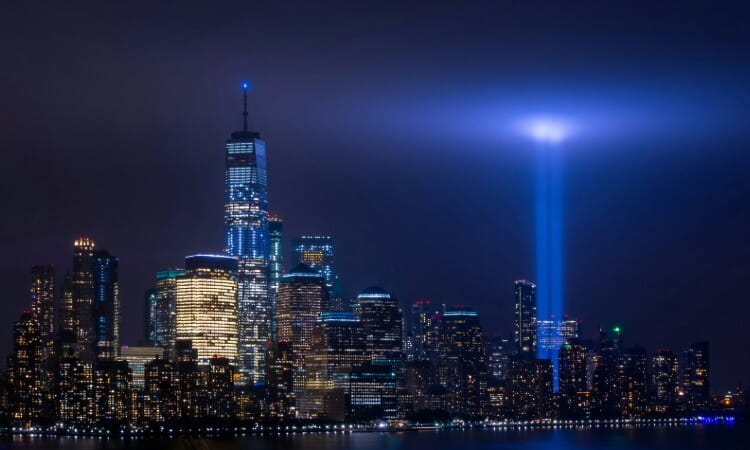
For 25 years, stories told about the 9/11 terror attacks have grappled with questions of truth, reality and bearing witness to trauma.
9/11 was a highly visual event. The image of the plane hitting the second tower was played over and over on a loop. This repetition of the horror echoed the way trauma itself can be compulsively replayed, remembered or re-enacted by the people who experience it. Another image was captured but self-censored by American media outlets, after complaints by readers. The image, taken by Associated Press photographer Richard Drew, was of an unidentified man plunging to his death, preferring to fall rather than burn.
The endless framing of the attacks in the media is echoed in fiction that explores 9/11, including the importance of testimony and the ways we process trauma. A related theme, too, is the way the attacks changed life in America, especially for people of Pakistani or Arabic backgrounds.
These five important 9/11 novels all attempt to make meaning out of this suffering.
1. Extremely Loud and Incredibly Close
Jonathan Safran Foer’s Extremely Loud and Incredibly Close (2005) is perhaps the most famous work of 9/11 fiction. It was later adapted as a 2011 film starring Tom Hanks.
The traumatic concern with framing the moment of the disaster and its repetition is the primary symptom of nine-year-old Oskar Schell’s grief after the presumed death of his father in the 9/11 attacks. Struggling to comprehend the possibility of his father’s death, Oskar desperately searches for meaning in his now-upended world, following “clues” he believes will reveal his father’s final message to him.
Oskar artificially frames his experience through these clues, seeking to make sense out of meaningless fragments. After finding a scrap of paper which reads only “Black”, Oskar travels New York City, attempting to identify the Mr or Mrs Black the note refers to. He also creates a scrapbook, “Stuff that Happened to Me”, where he incorporates images and evidence of atrocities that have happened to others.
Both the search for the unknown person and the scrapbook demonstrate how Oskar seeks connection with others in order to understand his trauma. Included in his scrapbook is an image of the falling man. However, Oskar reworks copies of the image, making them appear in reverse order. Imagining the man is his own father, he does not simply pause time, but rewinds it, moving the man back to the time before. Back to safety.
The novel’s use of the child narrator attempts to strip back the grief and suffering wrought by 9/11 to its purest form: the struggle to understand.
2. The Zero
Jess Walter’s The Zero (2006) delves into the post-traumatic effects of 9/11 on individuals, told through the perspective of Brian Remy, a New York police officer who survived the attacks.
It presents a series of fragments conveying the lapses in Remy’s memory as he struggles with the event, and with being identified as a hero everywhere he goes. Paradoxically, he and his colleague feel a strange happiness in this new acknowledgement of their work.
The Zero is interested in other kinds of falling fragments, especially paper, an image the novel opens with:
They burst into the sky, every bird in creation […] Burning scraps of paper. All the little birds were paper. Fluttering and circling and growing bigger, falling bits and frantic sheets, some smoking, corners scorched, flaring in the open air until there was nothing left but a fine black edge.
Managing and reordering the jumbled and displaced papers, the detritus of civilisation, becomes a central task of a nation determined to demonstrate its continuing economic leadership after the attacks. In the contrast between order and disorder, bureaucracy and chaos, The Zero suggests we might, paradoxically, forget about the human cost of 9/11 by focusing too much on systems.
3. Falling Man
In Don DeLillo’s Falling Man (2007), the burning papers fall alongside a shirt:
He watched it coming down. A shirt came down out of the high smoke, a shirt lifted and drifting in the scant light and then falling again, down toward the river.
Caught in the moment of its fall, in the lull of time between the fall of the two towers, the shirt’s beauty as it falls signifies the moral strangeness of creating art – the novel itself, and the famous news photograph of the falling man – from trauma.
As DeLillo wrote in December 2001, the role of the writer or artist in response to 9/11 is “to understand what this day has done to us”. For this reason, he adds, the writer tries to create a “counter-narrative” to the act of terrorism from the “hundred thousand stories crisscrossing New York, Washington, and the world”.
Like Safran Foer’s and Walter’s novels, Falling Man is concerned with the impacts on particular individuals, including children. While the effects can be devastating, the novel also attests that both telling and hearing these stories enable us to understand through connection. They make us stronger by testifying to our survival.
4. Home Boy
For H.M. Naqvi in Home Boy (2009), the “counter-narrative” must also encompass those who experienced racialised hatred in the days, weeks and months following the 9/11 attacks. His award-winning novel centres the experiences of a group of young Pakistani–American men. Its distinctive voice captures the particularities of youth dialect in an echo of JD Salinger’s The Catcher in the Rye (1951).
Prior to 9/11, Shehzad (nicknamed Chuck) and his friends were entirely at home in New York City, which appeared to welcome its new inhabitants:
You […] could spend ten years in Britain and not feel British, but after spending ten months in New York, you were a New Yorker, an original settler, and in no time you would be zipping uptown, downtown, crosstown, wherever.
But after 9/11, the city and its people turn on them, making these newcomers the object of all their fear and hatred. Ultimately, the boys are “arrested, interrogated, thrown into solitary confinement”. Although Chuck is released, he has changed after his experience, and the city itself has changed: “I’m afraid all the time. I feel like a marked man. I feel like an animal.”
In Home Boy, we see the way 9/11 has upended the principles of freedom and refuge once at the heart of American life, and inscribed on the Statue of Liberty.
5. The Reluctant Fundamentalist
Mohsin Hamid’s The Reluctant Fundamentalist (2007) extends this conceptualisation of the “counter-narrative” and those who are no longer considered to belong in America after 9/11. Its framing story explicitly draws attention to the ways self-identity – both individual and collective – is constructed via story.
The Pakistani protagonist, Changez, is a modern-day Sheherazade. He holds a nervous American as captive audience, as they sit at a cafe in Lahore. Changez, who achieved academic and professional success in the United States, believed in the American Dream.
But after 9/11, like Chuck in Home Boy, he becomes a marked man, the object of hate speech and avoidance. In response, his own attitudes towards the US change, and he returns to Pakistan. He expresses these fiercely on camera after one of his students is arrested for a terrorism attempt in the US: “When the international television news networks came to our campus, I stated to them among other things that no country inflicts death so readily upon people so far away, as America.”
While Changez’s politics are left ambiguous, the novel suggests fundamentalism is a response to marginalisation and exclusion. Again, we see how the wound is wrought not only by the traumatic event of 9/11, but by its aftereffects – and the act of its framing.
The article has been republished from The Conversation under the Creative Commons license. Read the original article.