Self-healing batteries the focus of $1.3 million ARC-funded UniSQ research
2 min read
16 Sep 2026
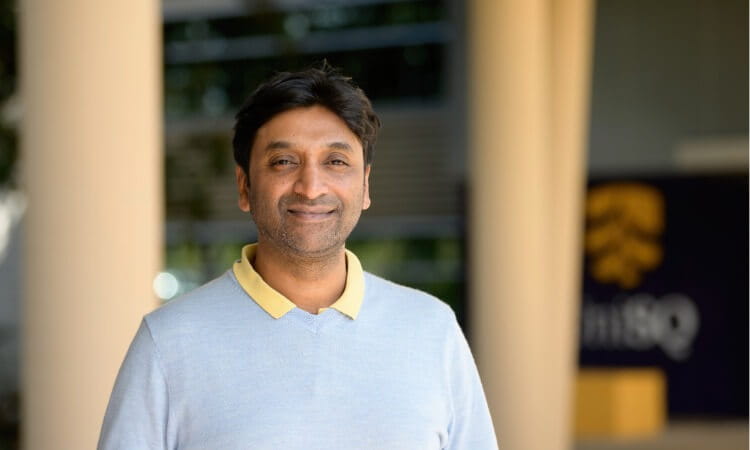
Batteries that can repair microscopic damage caused by repeated charging and discharging are the focus of a new University of Southern Queensland (UniSQ) research project led by Professor Ashok Kumar Nanjundan.
Rechargeable batteries gradually lose performance as they are used, with repeated charging and discharging creating mechanical stress that can cause microscopic cracks, loss of electrical contact and deterioration of the electrode.
The challenge becomes even greater when thicker electrodes are developed to store more energy.
Professor Nanjundan’s research aims to develop self-healing sodium-ion battery electrodes that can respond to mechanical damage during operation and maintain their structure and performance for longer.
“Every rechargeable battery gradually ages as it is used, but our research asks a simple question: what if a battery electrode could repair this damage itself?” Professor Nanjundan said.
The research has been awarded $1.3 million through the Australian Research Council’s (ARC) Future Fellowship scheme. It will combine specially engineered, defect-rich graphene with dynamic polymer networks to create battery electrodes that can repair damage.
The graphene will provide highly conductive pathways for electrons while helping researchers engineer the interfaces within the electrode. At the same time, the dynamic polymer networks will be designed to reconnect damaged regions as cracks and other defects develop.
“Rather than allowing damage to accumulate progressively over hundreds of cycles, we want to design materials that can reconnect damaged regions and restore contact,” Professor Nanjundan said.
The research will focus on sodium-ion batteries, an emerging technology that could complement lithium-ion batteries in applications including stationary energy storage where cost, lifetime, sustainability and supply-chain resilience can be important. The technology will also be helpful for lithium-ion battery electrodes.
Sodium is abundant and widely available, providing a more sustainable and diverse source of materials for energy-storage technologies.
Professor Nanjundan said the research was particularly relevant as Australia increased its use of renewable electricity and demand for reliable and affordable energy storage grew.
“Our research addresses an important challenge in moving from promising laboratory materials towards practical batteries – developing thick, high-loading electrodes that can store useful amounts of energy without rapidly deteriorating,” he said.
The project will also investigate thick, solvent-free electrodes, linking fundamental materials research with the manufacturing challenges of producing advanced batteries.
The research builds on more than a decade of Professor Nanjundan’s work in graphene and functional nanomaterials, advanced electrode materials and next-generation energy-storage technologies, including sodium-ion batteries.
“The Future Fellowship brings these different strands of research together in a new direction around the concept of self-healing battery electrodes,” he said.
“My vision is to move from batteries that simply tolerate damage to batteries that can actively repair it.
“If we can understand and control that process, we could create longer-lasting batteries while reducing waste and making energy storage more sustainable.”
The research will also strengthen Australia’s capability in next-generation battery science and environmentally sustainable manufacturing, while supporting national and international collaborations in advanced energy-storage materials.
Related news
3 min read
26 Oct 2026
3 min read
23 Oct 2026
5 min read
22 Oct 2026