Exploring the dark side of the Universe
3 min read
09 Jun 2026
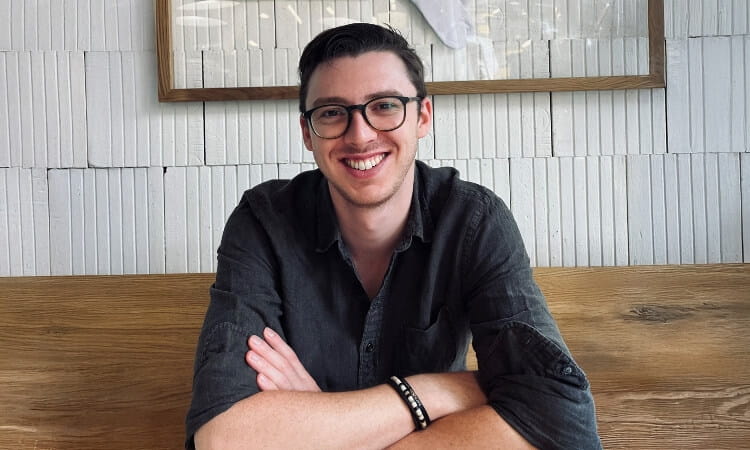
A childhood fascination with the Universe has taken Dr Alex Rawlings from Toowoomba to some of Europe’s leading astrophysics institutions, with the UniSQ alumnus earning one of Finland’s top honours for astronomy research.
Dr Rawlings, who graduated from UniSQ with a Bachelor of Science (Physical Sciences) in 2019, recently completed his PhD at the University of Helsinki, where his research explored the behaviour of supermassive black holes and the dynamics of massive galaxies.
He recently received the Väisälä Prize, recognising the most outstanding PhD thesis in astronomy completed in Finland over the past two years, and is now continuing his research as a postdoctoral scientist at the Max Planck Institute for Astrophysics.
Reflecting on his journey, Dr Rawlings said UniSQ played an important role in helping shape his pathway into international research.
“I chose UniSQ as it was one of the few universities in Australia that offered an undergraduate program that was a blend of physics and astrophysics,” he said.
“I was hesitant to specialise too early, and so this was an ideal compromise.
“I also grew up in Toowoomba, and at the time of my undergraduate studies, felt that staying close to family whilst I underwent the school-university transition was the right choice.”
Dr Rawlings completed a thesis in stellar astrophysics at UniSQ before undertaking a summer internship at the University of Sydney focused on observational extragalactic astronomy.
That experience ultimately led him to Europe, where he completed both his Master’s degree and PhD in Finland before moving to Germany earlier this year.
Dr Rawlings’ research centres on supermassive black holes – compact objects with a mass up to a billion times that of our Sun – found at the centre of most massive galaxies, including the Milky Way.
“In simple terms, my PhD research focused on the dynamics of supermassive black holes in massive galaxies,” he said.
“When two galaxies collide, we predict that their black holes will merge in a burst of gravitational waves – ripples in the fabric of space-time – that we have yet to detect.
“The instruments to do this are being built now, and it’s our job to provide the theory and models to make sense of what we will see.”
He said receiving the Finnish thesis award was both unexpected and deeply meaningful.
“To be selected for this award means that other people who were not involved in my research also found it interesting,” he said.
“Ultimately, we do what we do to share with the wider community, and so I am glad that my work has sparked the attention and curiosity of people unknown to me.”
Now based in Munich, Dr Rawlings is continuing to investigate the relationship between supermassive black holes and dark matter – one of the greatest unanswered questions in astrophysics.
“We don’t know what dark matter is, we just know that it’s there, it makes up roughly 27 per cent of the Universe,” he said.
“Understanding the interplay between black holes and dark matter can help us to constrain what this stuff actually is.”
The UniSQ alumnus said his upbringing in regional Queensland continues to shape his perspective.
“I am incredibly grateful for my childhood in Toowoomba,” he said.
“Oftentimes, one needs to leave home to fully appreciate the norms and aspects that we take for granted and are privileged to enjoy.”
Dr Rawlings encouraged current UniSQ students considering research careers to embrace challenges and opportunities alike.
“You will get to meet some incredible people, but do not forget that to others you are also an incredible person, and together this is what makes a community worth being a part of,” he said.
“Studying internationally has opened doors for me that I would not have thought possible when I was in school.
“The field of research in particular is a global community – I work with teams across Europe, the United States, and Australia.”
Related news
7 min read
23 Sep 2026
2 min read
16 Sep 2026
2 min read
16 Sep 2026