Sustainability, trade-offs and lived realities
5 min read
07 Jan 2026
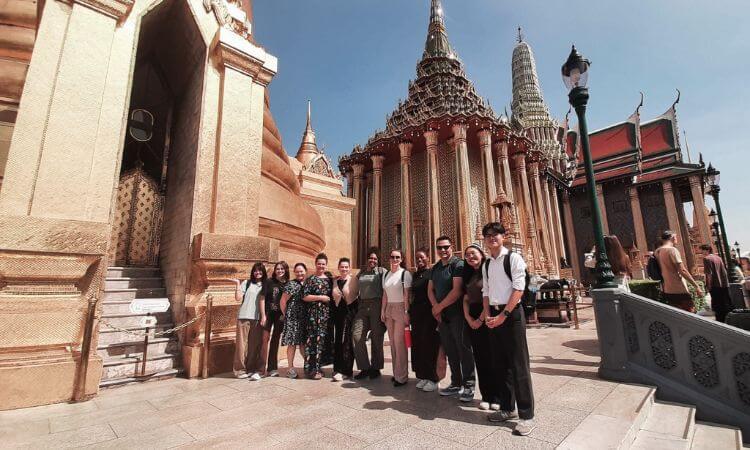
From bustling city streets to behind-the-scenes conversations with tourism leaders, University of Southern Queensland (UniSQ) business student Hollie Knott gained far more than classroom knowledge during a two-week immersion in Thailand.
Delivered through a partnership with Mahidol University and supported by Kasetsart University, the trip saw Hollie and five of her fellow Bachelor of Business students learn more about sustainable tourism and global business practices.
The program included visits to hotels, universities, government departments and tourism operators, offering firsthand exposure to sustainability, culture, economics and business strategy.
While formal presentations and guided site tours delivered valuable real-world insights, it was observing everyday life in Thailand that left the most lasting impression on Hollie.
We caught up with her to hear more about the experience.
When did sustainability first feel real for you?
The first place this question became real for me was not on a beach or in a resort. It was inside a shopping mall in Si Racha, in Thailand’s Chonburi region. At first, it looked like an impressive retail centre. But the longer we spent there, the more it revealed itself as something else entirely.
Thai shopping malls make Australian shopping centres feel almost minimalist by comparison. They are not just places to shop; they function as fully integrated community hubs. Apartments in the area are often smaller, many homes are not air-conditioned, and daily life extends well beyond the domestic space. A mall that offers air-conditioning, food, healthcare, co-working spaces, childcare and entertainment in one place is not indulgent – it is infrastructure.
At the same time, this is where sustainability becomes genuinely complex.
How did this challenge your understanding of sustainability?
It revealed how environmental ideals often clash with everyday necessity. Comfort, convenience and daily needs frequently sit in tension with environmental goals. Plastic is everywhere, not because people don’t care, but because more sustainable alternatives are often less accessible or affordable. Balancing environmental responsibility with what people rely on day to day is not straightforward, and Thailand makes that challenge impossible to ignore.
What insights did luxury hotels offer about sustainable tourism?
We visited two luxury properties – the 137 Pillars Hotel and RXV Wellness Resort. Both care deeply about sustainability, but they also operate within real financial and operational limits.
At 137 Pillars, for example, we learned that shifting hotel laundry to off-peak hours could reduce environmental strain. However, doing so would significantly increase labour costs due to wage structures, making the change financially unviable. Other sustainability initiatives would impact guest comfort in ways that were not realistic for a luxury environment.
Standing in that laundry room, it became clear that sustainability is not about being perfect. It is about understanding real trade-offs, making informed choices and improving where you realistically can. Sometimes progress happens in small, steady steps. Sometimes it cannot happen at all.
Where did you see tourism working alongside local communities?
If the malls and hotels showed us the systems behind tourism, the coastal community of Ao Udom showed us the people. This is a community working to keep local culture and livelihoods connected to tourism, rather than displaced by it.
Instead of tourism happening to the community, these initiatives allow tourism to happen with the community. We took part in a traditional tie-dye workshop, learned to make som tum (Thai papaya salad), and visited the nearby crab bank, where we released baby blue swimming crabs to support local fish populations.
These experiences showed how tourism can create direct income for local families, keep traditional knowledge active and protect the natural systems that local livelihoods depend on.
They were not presented as perfect solutions; however, they were thoughtful, practical initiatives that quietly protect community identity within a growing tourism economy.
This reminded me that sustainability is about protecting people, not just the environment.
How is Thailand rethinking its tourism model?
By shifting focus from volume to value.
A session with representatives from the Tourism Authority of Thailand and the Australian Embassy highlighted how Thailand is actively reshaping its tourism industry. The country is moving away from a volume-driven approach towards quality over quantity, prioritising longer stays, higher-value travellers and deeper local engagement.
Under Thailand’s 2026 tourism direction, success is measured by community benefit and sustainability outcomes, rather than visitor numbers alone. Cultural context shapes how policy is implemented, with seniority, long-term relationships and gentle feedback playing key roles in decision-making.
Was there a moment that had a personal impact beyond academics?
One of the most powerful moments of the trip wasn’t in a lecture or a boardroom.
While practising our final industry presentation, I kept interrupting myself to apologise or over-explain. My professor stopped me and said, simply, “I don’t know why you do that.” He explained that by voicing my doubt out loud, I was creating uncertainty that didn’t exist. If I hadn’t said anything, no one would have questioned my capability at all.
The lesson wasn’t to be more confident. It was to stop giving voice to doubts that had never existed.
Why did this immersion matter as you approach graduation?
This immersion reshaped my understanding of sustainability. I learned that it is not something that can be achieved through simple checklists or good intentions. It is built through systems, trade-offs and everyday decisions that shape who benefits and who is excluded.
As I graduate, I am grateful that my final university experience challenged not just my knowledge, but my character. The lessons from Thailand will stay with me in the choices I make and the systems I question.
Learn more about where UniSQ’s Bachelor of Business can take you.
Related news
3 min read
23 Oct 2026
5 min read
22 Oct 2026
2 min read
16 Oct 2026