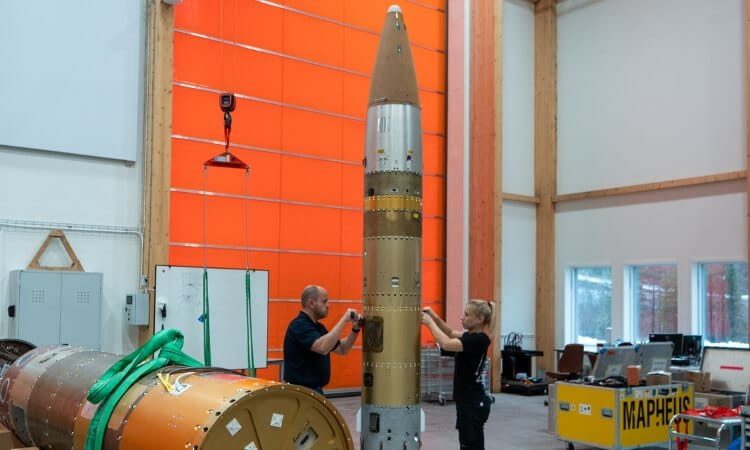
The University of Southern Queensland (UniSQ) has taken a major step in strengthening Australia’s hypersonic research capability, successfully flying a new hypersonic flight experiment aboard the German Aerospace Center’s (DLR) MAPHEUS-16 mission.
Developed under the iLAuNCH Trailblazer Fast Track Program, the GAsFEx-2 (Germany–Australia Flight Experiment) demonstrator provides a flight-proven, low-cost platform for industry and researchers to access real hypersonic data – a capability that is typically expensive, complex, and difficult to obtain.
Led by UniSQ in collaboration with the Technical University of Munich (TUM), DLR’s Mobile Rocket Base, and Queensland aerospace startup HyperFlight Systems, the mission reinforces UniSQ’s role in building future hypersonics capability for Australia.
Professor Ingo Jahn, project lead at UniSQ’s Hypersonics and Rocketry Group, said the mission further demonstrates the University’s growing global leadership in high-speed flight research.
“This successful flight test is a key step towards making hypersonic flight testing more accessible and affordable, and creates a critical research capability,” Professor Jahn said.
“By demonstrating our ability to design, manufacture, and fly ride-along hypersonic payloads, we’re opening new opportunities for industry and academia.
“Flight data is critical in the development of hypersonic technology – to validate systems, evaluate new materials, or test theoretical models and computational simulation tools.”
The experiment offered a novel “ride-along” approach that allows small aerothermodynamic experiment payloads to share sounding rocket missions.
“This approach significantly reduces the cost and complexity of hypersonic flight testing by as much as 95 per cent compared to traditional standalone rocket missions,” Professor Jahn said.
Building on the GAsFEx-1 flight in 2024, the latest mission incorporated enhanced avionics and improved measurement and recovery mechanisms to strengthen the platform’s capabilities for future research applications.
The experiment and sensors designed by the team at UniSQ, together with a bespoke avionics package developed by HyperFlight Systems, were integrated into the forward nosecone and launched by DLR’s Mobile Rocket Base as part of the MAPHEUS-16 flight.
The successful launch and recovery of GAsFEx-2 is a major achievement of the iLAuNCH Trailblazer Fast Track Program, which drives high-impact collaborations between industry and research to advance Australia’s sovereign space capability.
Learn more about iLAuNCH Trailblazer and UniSQ’s hypersonics research.