Reuniting through art: Shared studios and representation for visual arts alumni
10 min read
18 Dec 2025
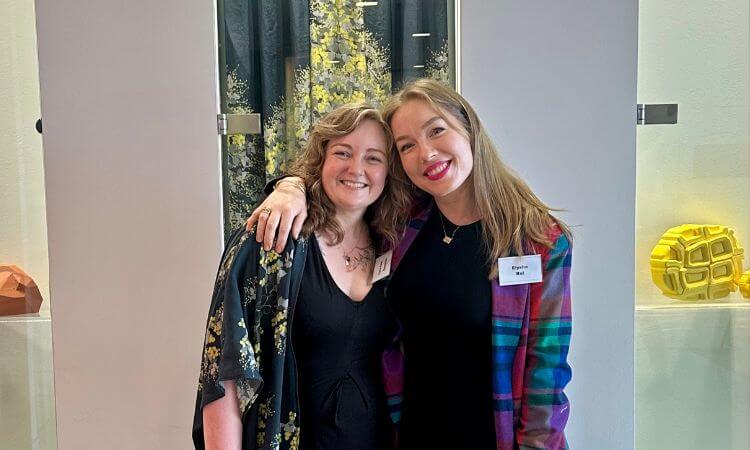
For University of Southern Queensland (UniSQ) visual arts alumni Elysha Rei and Cara-Ann Simpson, friendship has been a constant thread woven through two decades of creative practice.
Graduating together in 2007, the pair built their artistic foundations side by side – sharing studios, ideas and ambitions that extended well beyond the classroom.
While their careers have taken different paths across states and disciplines, their connection has remained strong. Now, the artists have come full circle, reunited through representation with Onespace Gallery in Brisbane.
It’s an experience that reflects both their enduring friendship and the strength of their UniSQ education.
We caught up with them to hear about their career journeys and their reunion.
What an amazing full-circle moment for you both. How did your friendship and shared time at university influence your early artistic development?
Cara-Ann:
Elysha’s friendship throughout my UniSQ visual arts studies was really important. That close peer connection created a place for honesty and reciprocity. By creating that space, I became more confident in expanding my experimentation and pursuing ideas that felt risky and hugely ambitious.
Our friendship is incredibly supportive, and we’ve always been each other’s cheerleader. Having Elysha’s friendship during that early artistic development period provided a space where we could see our futures as professional artists and leave doubt behind.
We both had a hunger to pursue professional practices and actively encouraged each other to develop and achieve ambitious goals. That shared motivation also kept us focused on our studies, while encouraging us to pursue professional practice before we graduated. Our friendship’s reciprocity continues to grow and flourish as we support and cheer each other on through our careers.
Elysha:
I remember those UniSQ VisArts days so fondly – and I remember Cara so vividly within them. She has always embodied independence, grit, and conceptual rigour. I was in awe of her stories travelling across Australia before beginning her degree, and she was the first in our cohort to think strategically about sustaining a practice – even securing paint sponsorship from Dulux to fund her materials! Cara’s drive and leadership inspired me to think more expansively about both the creative and professional aspects of being an artist, and that admiration has only deepened over the last two decades.
What does it feel like now to be represented by the same gallery as a long-time friend and fellow alumna?
Cara-Ann:
It is genuinely an honour and privilege to be represented by the same gallery as Elysha. Being represented by Onespace together is a full-circle moment and something I cherish.
The Onespace team comprises an incredible group of people, whose support has so many valuable benefits. To stand on the same platform as Elysha at this moment in time, as UniSQ alumni, is a remarkable and fulfilling experience.
Elysha:
To share gallery representation with Cara is a profound full-circle moment. Alongside building our careers, we’ve also shared a deep friendship shaped by resilience — particularly through navigating our own health challenges. That journey has created a bond rooted in honesty, humour, and admiration. To now stand side-by-side at Onespace Gallery feels like we are celebrating something hard-won – a milestone that recognises years of persistence, personally and professionally. It’s incredibly meaningful to have someone who understands, intimately, what it takes to arrive at this point. The team at Onespace have been incredibly supportive of my career over the last decade, so I’m looking forward to working together to see how the next chapter unfolds.
How have your paths intertwined or diverged since those early days at UniSQ?
Cara-Ann:
Our paths have certainly intertwined and diverged since our UniSQ days together. I moved to Melbourne in 2009 to pursue my career as an artist and arts worker. Meanwhile, Elysha was busy running artist-run spaces, developing international artist residencies, and exhibiting, all while being a mum!
My career has taken many twists and turns; I’ve exhibited internationally and developed expertise as a contemporary art curator, gallery manager, and cultural heritage and landscape director. Through it all, Elysha and I stayed connected.
With my return to Queensland, our paths intertwined once more. One of the beautiful things about our friendship is its timeless connection. We might not see each other in person for months, sometimes years, yet as soon as we’re in the same room, we find that same ease and familiarity. Now, our connection has expanded through shared professional experiences, personal hardships and our passion for art.
Elysha:
Since graduating, we’ve each forged careers as practising artists and arts workers, often moving across regional and metropolitan contexts, and I was also overseas in Thailand for a couple of years. We stayed connected through the gallery and museum network, where shared experiences brought both camaraderie and much-needed empathy.
Even when living far apart, we made the effort to stay in touch – sometimes to talk through professional decisions, sometimes just to support each other through life. Now that we’re both based in South-East Queensland again, it has been wonderful to reconnect in person, reminisce on those early years, and dream together about what comes next.
Elysha, your work is known for its intricate paper cuttings and site-responsive installations. How has your practice evolved over the years, and what keeps drawing you back to themes of history, memory and migration?
Elysha:
I could trace it all back to my third-year work at UniSQ – displaced koi fish, tentative experiments in installation, and a visiting artist workshop with Dr Megan Keating, where I first discovered paper cutting. At the time, I felt a little directionless but also free – I was trying everything, absorbing it all.
Becoming a mother shortly after graduating changed everything. It gave me a deep sense of purpose – both a need to succeed and a desire to understand which cultural memories and histories I wanted to pass on. It was during this time that my relationship with my Japanese grandmother deepened. She shared stories of meeting my Australian grandfather during the postwar occupation of Japan and her migration as a war bride. She was adamant that I understand our ancestral lineage, including Samurai heritage.
That became a turning point – my work shifted into a way of mapping family stories visually. Over time, this expanded into broader Japanese-Australian histories and later connected with other Japanese diaspora communities in North America. Working in an archive sharpened this further – I was surrounded by primary source material, and it became clear that my role as an artist could be to translate and illuminate histories that were overlooked or uncomfortable. My practice became my way of taking care of memory.
Your works often engage with Japanese-Australian histories. What inspired you to explore this area of identity and heritage, and how do archival materials inform your creative process?
Elysha:
My art practice became the bridge between my personal family history and a much wider historical narrative. Once I understood how layered and significant Japanese-Australian history is – including stories of early labour, wartime internment, and cultural resilience – I felt compelled to give it visual form.
Working professionally in an archive gave me direct access to documents, photographs, shipping manifests, and letters. These materials hold stories that rarely make it into public consciousness, and I see contemporary art as a powerful way to activate them – to create an entry point for understanding, especially when the histories are traumatic, hidden, or uncomfortable. My work becomes a translation between the archive and the viewer.
Cara-Ann, your practice merges art, technology and sensory experience. What first sparked your interest in connecting science and engineering with artistic expression?
Cara-Ann:
This really comes back to my UniSQ studies. There were key lecturers and staff who encouraged my natural interest in the nexus between art, science, engineering and sensory experience, including Kyle Jenkins, Ann-Maree Reaney, Michael Schlitz, Andrew MacDonald and Uros Cvoro, among others. They helped expand my art world perspective, and I pursued my love for the sensory world through this nexus.
During my undergraduate studies, lecturers encouraged me to exhibit professionally, including presenting my major installation at the Australasian Computer Music Conference in 2008 during my Honours year. There, I connected with Digital Signal Processing engineer Associate Professor Eva Cheng.
We collaborated on two major interactive technology installations: Noise Cancellation: disrupting audio perception (2009) and Geo Sound Helmets (2011). Eva remains a close friend and is now Head of School, Professional Practice and Leadership, Associate Professor, and Director of Transnational Education at the University of Technology Sydney.
Can you describe how sensory perception influences the way audiences engage with your installations or digital works?
Cara-Ann:
I’ve been interested in sensory perception for a long time; however, since living with chronic illness and disability, my focus has shifted. I am now much more aware of access needs, which led me to research different ways of learning.
Using this as a framework shapes my approach to integrated sensorial experiences. In my current touring project, Furari Flores, I developed artworks across sight, sound, smell and tactility. By engaging multiple senses, I aimed to create a more accessible experience that invited audiences to engage in ways that suited their individual learning and access needs.
I love speaking with people during exhibitions and hearing how they approached the work – what they noticed first, what stayed with them, and the memories it evoked.
Looking back at your time at UniSQ, what aspects of your education most shaped who you are as artists today?
Cara-Ann:
This is hard to narrow down! My peer group and the long-lasting friendships I developed through UniSQ were incredibly significant. Studying alongside focused and ambitious artists like Elysha gave me the confidence to pursue high-reaching goals.
Rather than a competitive environment, we built relationships founded on reciprocity, respect and a shared passion for art. This is why our shared Onespace representation means so much to us.
The course’s intellectual rigour, combined with the support and mentorship of UniSQ lecturers and staff, also played a huge role. The balance of studio practice and theory developed strong research, problem-solving and creative skills that continue to support my practice today.
Elysha:
The people – absolutely. The lecturers, many of whom we remain connected to, and the open, generous creative environment of the art school. UniSQ gave us room to experiment across diverse mediums, which was crucial in building confidence and finding direction. I also loved the interwoven creative community – visual artists mixing with theatre students, dancers, and actors. That cross-pollination was formative, and the alumni network remains remarkably strong.
And finally what advice would you offer current UniSQ visual arts students hoping to build a sustainable and meaningful creative practice?
Cara-Ann:
Start your professional practice now. Don’t wait for opportunities to come to you – figure out the place you want to have in the art world and what you want to achieve.
Seek out artists whose careers you admire, not just their artwork, and consider how they’ve built sustainable practices. University is an exceptional time to build professional networks and begin shaping your career while you still have the support and structure of the faculty.
Elysha:
Make the most of the time and resources you have – the studios, the equipment, the mentorship, and especially the freedom to experiment. Nurture your peer networks; the relationships you build now may become your lifelong creative community. And above all, develop a practice rooted in something meaningful – a story, an idea, a purpose that feels undeniably yours. The art world evolves constantly, but authenticity, resilience, and connection endure.
Learn more about Creative Arts at UniSQ.
Related news
5 min read
7 Oct 2026
7 min read
23 Sep 2026
2 min read
2 Sep 2026
Tags