McGregor School 2027
Five days of creativity, learning and connection.
Dates: Monday 18 January – Friday 22 January 2027
Location: UniSQ Toowoomba, West Street, Toowoomba
Program release: October, 2026
Registrations: McGregor School 2027 registrations are now open - Register now
For generations, McGregor has brought people together to learn from accomplished artists, explore new techniques and immerse themselves in creativity.
In 2027, McGregor will form part of UniSQ’s 60th anniversary year, celebrating six decades of connection between the University, our communities and the creative life of our region.
As one of UniSQ’s longest-standing creative and community traditions, McGregor has welcomed generations of participants to the Toowoomba campus. In this milestone year, we look forward to welcoming the McGregor community back and continuing that tradition.
Five days to create, learn and connect
The 2027 McGregor School will offer a diverse program of practical, hands-on workshops led by experienced artists and creative practitioners.
Whether you're an established artist looking to advance your practice, returning to a long-held creative passion, or exploring something entirely new, McGregor provides the opportunity to step away from the everyday and immerse yourself in a supportive and inspiring creative environment.
Spend five days learning new techniques, sharing ideas, and creating alongside people who share your curiosity and passion for making.
2027 McGregor School program
Experimental Journalling is a five-day workshop exploring the methodology of artistic practice through play, research, testing and experimentation. Working across drawing, mark-making, line work, watercolour, acrylic and mixed media, participants will work through a series of journalling exercises designed to challenge familiar approaches and open up new possibilities. Through layering, material exploration and visual experimentation, journals will be transformed into collections of artworks that document, reflect and extend an individual practice. The workshop explores not only the how of making art, but the why of our practice. Through hands-on experimentation and reflection, participants will investigate their artistic choices, motivations and visual language, developing a deeper understanding of the ideas that underpin their work and the connections that bring coherence to their practice.
Alex Stalling is a multidisciplinary artist, arts educator and creative director based in Toowoomba, Queensland. Working across painting, drawing, watercolour and collage, her practice explores memory, personal identity and shifting emotional narratives through intuitive image-making, representational motifs and layered compositions. Using repetition, automatic mark-making and bold, intense colour, she investigates the relationships between instinct, intention and the ways meaning changes over time. Alongside her studio practice, Alex has founded artist-run spaces, directed gallery programming, delivered public art and community projects, and developed creative education programs. She is the founder and director of Tinker Art School.
Students are required to bring some of their own materials for this workshop, including:
- Acrylic paint
- Gouache
- Watercolour
- Paper
- Art journals
- Scissors and cutting blade
- Cutting mats
- Graphite pencils
- Colour pencils
- Sharpener & erasers
- Carbon paper
- Glue stick
- Paint brushes
- Permanent markers
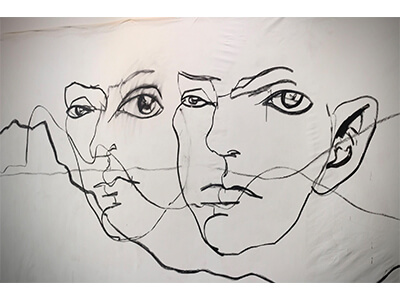
Explore observational and experiential drawing exercises with a focus on figure and portrait drawing. This five day series will explore drawing as a process for creative development and active meditation, while developing skills of observation and methods for resolution of two dimensional figurative artworks. Practice large scale drawing using mixed media including charcoal and ink, and explore a variety of drawing surfaces. For Artists and Art Educators looking to develop new perspectives and techniques with a focus on the human figure and portraiture.
 |
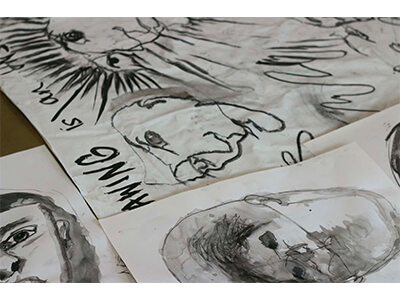 |
Alice Rigby is an Artist and Educator based in South East Queensland. Her work has featured in numerous solo and group exhibitions across Australia, and she has participated in Street Art projects both locally and internationally. Alice currently lectures in Visual Arts at the University of Southern Queensland.
Students are required to bring some of their own materials for this workshop, including:
- Charcoal
- Black waterproof drawing ink
- Variety of brushes
- Butchers paper
- A1 110gsm cartridge paper
- Calico roll and house primer
- 300gsm cotton large watercolour paper sheets 560x760mm hot press (2 per student)
- Monte Marte Single thick canvas 50x70cm (2 per student)
- Staple guns and staples
- Water spray bottles
- Chux rags
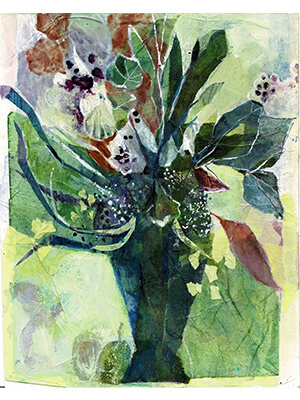
Designed for artists ready to move beyond literal observation and habitual assumptions. Annette will guide you through visual foundations, giving you a strong anchor to freely explore, trust your instincts, and find your unique approach without rigid technical rules. Use mixed media of your choice including watercolour, inks, white paint, opaque colour, dry media - whatever you wish to explore your ideas.
 |
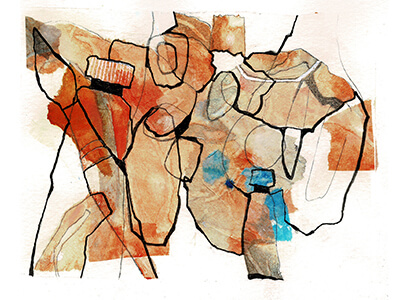 |
Annette Raff has a strong background in art and design, specialising in drawing and water media. She holds a Bachelor of Fine Art, an Advanced Certificate in Art and Design, and is a Fellow of the Royal Queensland Art Society. Not bound by traditional methods, Annette encourages an exploratory approach to artmaking in her classes. She is a popular tutor with 28 years of teaching experience, having taught at the Royal Queensland Art Society, USQ McGregor Art School, Buderim Winter School, and Creative Injune. Her work has been recognised in numerous awards, including highly commended and finalist placements in the Lethbridge 20000 Prize, Tattersalls Landscape Prize, and Brisbane Portrait Prize – Salon des Refusés.
Students are required to bring some of their own materials for this workshop, including:
- Paper: 3 × A3 sheets (300 gsm cold-pressed watercolour paper, brand of your choice). Primarily for cuttinginto smaller rectangular and square pieces; A4 or A3 may also be used for an optional larger work on the final days
- Acrylic medium – matt (I use Clear Gel Medium Matt Matisse or similar for sticking paper)
- Pencils - Graphite a range of HB to 7B
- Zig Kuretake or Luma White 30 ml bottle
- Masking tape (12 mm or narrower)
- Scissors for cutting collage papers
- Ruler (occasionally)Water containers: 2 jars or yoghurt containers (approx. 680 g)
- Toothbrush (for spray texture)
- Pipette or small squeeze bottle
- Sponge – cellular type (available from supermarkets)
- Glue stick
- Palettes – 1 large palette with plenty of mixing space – 3 smaller palettes – small dishes for mediums, inks, or acrylics (to avoid staining your main palette)
- Eraser - I use Factis Gum Eraser and a Kneadable Eraser
- Clear A4 sheet protectors – for storing your collage paper (in binder if you wish)
- Backing Boards – Minimum 3 lightweight boards (no larger than A3) we work on multiple pieces at a time –Coreflute boards work well (black or white) available at Bunnings or Officeworks (cut to A3 approx.)
- Cropping Tools (viewfinder) - 2 x L shape pieces of cardboard to use as - preferably cream, white, black or neutral colour
- Paint Brushes – We use a variety of brushes to produce all sorts of marks and washes in this workshop. Bring along what you have but no oil painting brushes. Bring a combination of small round well pointed, medium and larger brushes. Bring a variety of flat brushes approx. 1/2" to 1" Older flat 1"brush for applying glue if needed
Strongly recommended
- Camera, iPad, or iPhone for reference photos
Other “optional” (could be fun!) materials, but not essential
- Paper alternative surfaces –
- Illustration board
- Canvas boards (prepared with Gesso or Watecolour Ground)
- Clay board
- Water media boards (Purchased already prepared for watercolour eg. Fredrix)
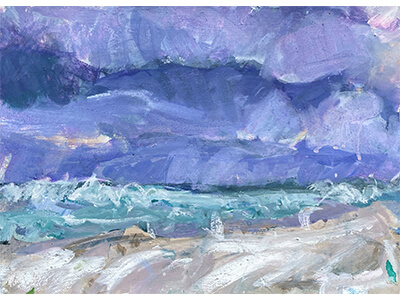
Taking an intuitive and gestural approach, we will create a series of mixed media paintings that express an emotive response to our coastal environments. We will explore how mark making, layering, texture and experimental surfaces can create dynamic and expressive seascapes that convey feeling without being overly descriptive. To get started please bring a variety of coastal images, these may be from Stradbroke Island or perhaps the Sunshine Coast or Gold Coast, where ever inspires you. Use colour printouts, a tablet, books or magazines. These images will serve as initial ideas and jumping-off points for our paintings. Through a series of experimental exercises, we will explore a range of mixed-media, including acrylic paint, dry media, gelli prints and collage.
 |
 |
Clare Purser is a Brisbane-based Practicing Artist and Art Educator; she works as a Painting Tutor with the Brisbane Institute of Art and teaches with a variety of art schools around Australia. Central to her practice is en plein air painting, seeking to capture a connection to the landscape through painting and drawing. A primary theme of her work is the environment, with a particular focus on the high conservation value such as the Border Ranges; its Gondwana rainforests and Moreton Bays Ramsar Wetlands. Clare is represented by the Woolloongabba Art Gallery in Brisbane. Her work is held in private and public collections; she has been a finalist in many art prizes and won the Milburn Art Award in 2016.
Students are required to bring some of their own materials for this workshop, including:
- Acrylic paints – when painting costal sea-scapes, the following blues are important; ultramarine, phthalo blue and cobalt blue. Please also bring the following colours of substitutes, white, med yellow, warm red, quinacridone magenta or violet, raw umber, burnt sienna or raw sienna.
Please use whatever paints you have, but goods brands are Matisse, Golden, Atelier or Windsor & Newton - Range of different sized brushes
- Palette knife
- Selection of dry media (whatever you have) e.g. Ink-tense pencils, neo-colour water soluble pastel, a graphite pencil, coloured pencils, soft pastels or oil pastels
- A pad of large paper for exploratory paintings A3 or larger (300gsm watercolour or mixed media paper)
- A sketchbook or paper pad for notes and preliminary sketches (whatever you have, but landscape orientation preferred)
- 2 x canvas, boards, cardboard or heavy paper to complete paintings on, whatever size you are comfortable with
- A gelli plate and roller
- Thin paper on which to print your gelli prints – rice paper, thin cartridge or photocopy paper is fine
- Scissors, masking tape and glue
- A palette (baking paper taped over a board makes a great disposable palette)
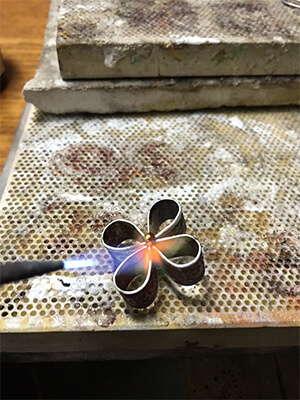
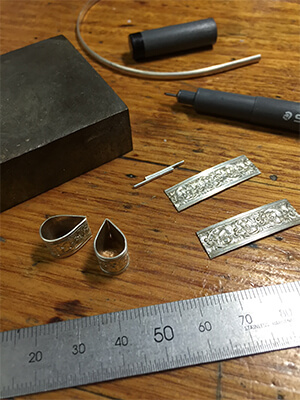
Explore contemporary jewellery and object-making in this hands-on, week-long workshop, transforming everyday materials and personal ideas into unique wearable pieces and small sculptural objects. Through demonstrations, experimentation and individual guidance, you’ll explore materials, techniques, form, texture, colour and composition while developing your own creative approach. Suitable for beginners and experienced makers alike, no previous experience is necessary—just curiosity and a willingness to experiment. By the end of the week, you’ll have created original pieces to take home, along with new skills and inspiration to continue your creative practice.
 |
 |
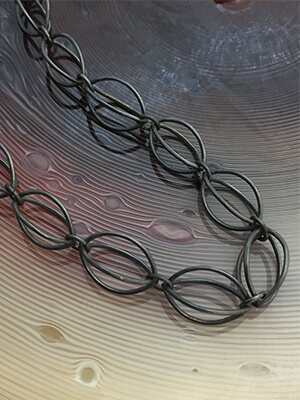 |
Kathryn Wardill is a contemporary glass artist and jeweller who received her Master of Arts, in Fine Art by research from RMIT University. Wardill has actively participated in group and solo exhibitions internationally for over 30 years. Wardill is dedicated to researching jewellery objects combining glass and metal, which has resulted in teaching over 180 workshops, solo exhibitions, being an artist in residency in the USA, and being represented by Studio Ingot Melbourne.
Students are required to bring some of their own materials for this workshop, including:
- Their own tools and stones if they have them and silver, copper, brass (sheet, wire and silver solder hard/medium/easy solder) if they have it.
- Round stones either faceted or cabochon are preferred for beginners.
- Inexpensive Cubic Zirconia’s are suitable preferably no larger than 10mm for beginners
- Note pad and pen
- Magnifiers or strong glasses, if needed to see close up work
- Apron, safety glasses
Basic tool kit
- Jeweller’s saw frame (fixed frame is tutor’s preference)
- Jewellers saw blades size 2/0 - Best purchased in pack of 12bundles of 1 dozen blades
- Stainless steel pointed tweezers for soldering
- Half round pliers (smooth jaws)
- Flat pliers (smooth jaws)
- Jeweller’s snips for solder
- Needle file set
- Half round file (No 2 cut and 16mm wide)
- Emery paper 400, 600, 800 grades, one sheet each
Metal
- Copper or Brass sheet for practice for beginners, size approx. 10 cm x 10 cm x 1 mm
- Optional - Silver Sheet - 1 mm for general work
- Optional - Silver wire - 1mm
- Silver solder - easy, medium and hard (2cm x 2cm square approx. of each available in small sheets)
Tools and silver can be purchased from:
- Koodak’s Jewellery Suppliers
- Australian Jeweller’s Supplies Pty Ltd
- Twin Plaza Metal
- Bunnings
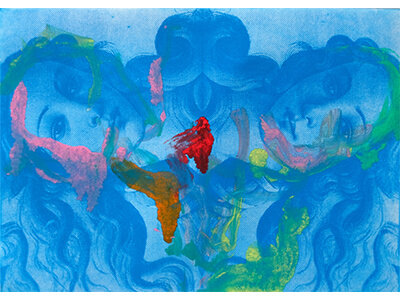
In this workshop you will learn the technical skills to create a portfolio of artworks using solar plate etching, dry point etching, monotype printing, and collage. Participants will utilise line, colour, imagery, layers, abstraction, surrealist aesthetic and composition, to create artworks that communicate student-led meaning and narrative. Participants will learn to harness juxtaposition and intuition to create interesting and creative print works. This workshop will build your confidence to take creative risks and to reflect on your process and art making.
 |
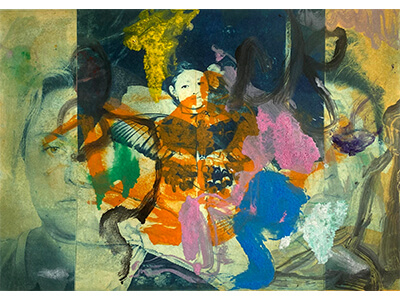 |
Kristen Flynn is a contemporary artist that utilises printmaking and new technologies to create works that investigate and communicate identity. Living on a rural property, and being a mother, Flynn is drawn to investigating facets of motherhood, life cycles, decay, and beauty, through found objects and images from her surroundings.
Students are required to bring some of their own materials for this workshop, including:
- Collection of own imagery (min 30 images) that have a personal connection to you (especially symbolic) and not larger that A4 (own drawings, magazine cutouts, photos, photocopies of favourite artworks etc.)
- Own art journal
- Box of disposable gloves (approx. 100)
- Printmaker's paper (white) 250gsm to 285gsm (Fabriano Rosaspina paper or Fabriano Unica paper) approx. 6-8 large sheets
- Dry point etching needle/ scribe
- Long steel ruler (45-60cm)
- Box cutter with blade refills
- Phone book (if you can source one)
- Cheap paint brushes of varying size (approx. 3 different sizes)
- Small bottle PVA glue
- Small watercolour palette
- HB or 2B pencils, coloured pencils, eraser, scissors, sharpener, glue stick
- Oil paints: black (any), white (any), Prussian blue, red (any), yellow (any). NB Please no cadmium and no water-soluble oils)
- Small to med tubes are fine, feel free to bring any additional colours you might already have
- Faber Castell Art Pitt Pens (Black)
- Drawing Artist Fineliner Set of 8 pens (no sharpies)
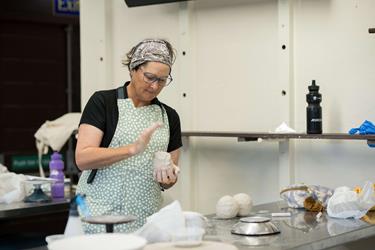
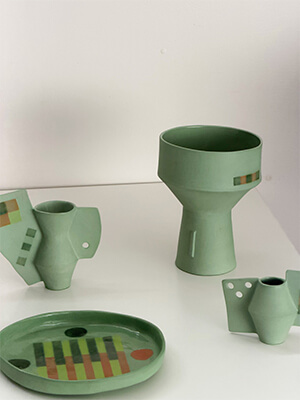
Join ceramic artist Peta Berghofer for a five-day, project-led workshop exploring hand-built ceramics and the expressive possibilities of colour-stained clay. Through guided experimentation with abstract sculptural forms, pottery stains and surface techniques, you’ll develop work that reflects personal meaning while pushing creative boundaries. Suitable for beginners and experienced makers alike, the workshop will support you to create exploratory pieces and one resolved medium-to-large artwork that expresses your unique creative voice and personal storytelling.
 |
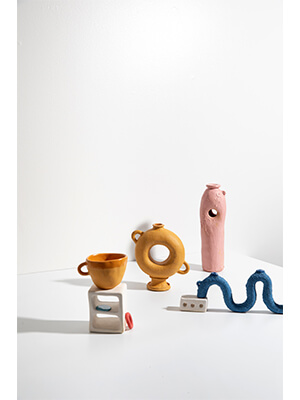 |
Peta Berghofer is an artist based in Toowoomba Queensland, practicing on Giabal and Jarowair lands. She holds a Bachelor of Creative Arts, with First Class Honours from the University of Southern Queensland (UniSQ). Berghofer has exhibited across Australia and internationally in France and Denmark and has participated in artist residencies abroad. Her work is held in private and public collections and has featured in awards such as the Siliceous Award for Ceramic Excellence and the Klytie Pate Ceramics Award.
Students are required to bring some of their own materials for this workshop, including:
- Needle tool
- Cutting wire
- Ribbon tool
- Steel rib
(Note: if you don't already own these items, it can be more cost effective to purchase a kit) - Serrated steel rib
- Rubber rib
- Variety of round paintbrushes (small to medium) for applying clay joining slip, so they don't need to be fancy
- Visual journal/ sketch pad/ notebook for design sketch work and note taking
- Eraser, pencil and pen
- Ruler
- Scissors
- Boxes and materials for packaging to transport raw work home
Additional $50.00 fee applicable for purchase of clay.
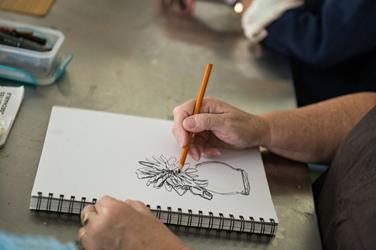
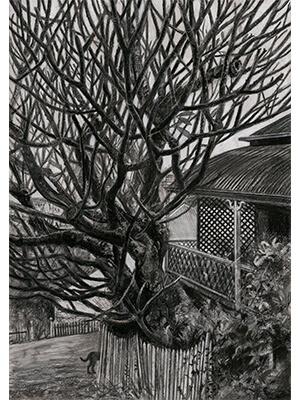
Discover the magic and versatility of charcoal in this five-day mixed media workshop, building practical skills in mark-making, tonal values, shading, composition and depth through guided exercises and hands-on exploration. Explore portraiture, landscapes, trees and plant forms while pushing creative boundaries by combining charcoal with acrylic paint and collage to create rich, textured and expressive artworks. A balance of skill-building, artistic discovery and creative freedom, this workshop invites you to discover the possibilities when drawing and painting come together.
 |
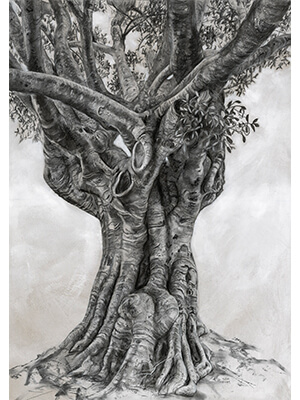 |
Robyn Bauer is a well-known Brisbane artist with her own gallery in Paddington. She was made a Fellow of the Royal Queensland Art Society in 2019. She has been Artist-in-Residence at the Brisbane Ekka in 2016 and the Mt Coot-tha Botanic Gardens in 2019. She was joint founder of Brisbane Urban Sketchers and has taught internationally. Her current work focuses on urban landscape paintings and charcoal drawings of the trees in the urban environment.
Students are required to bring some of their own materials for this workshop, including:
- Woodless charcoal pencils
- Willow or Vine charcoal sticks (both thick and thin)
- Blending stump or tortillon
- Kneadable eraser
- Sharpener and container
- Masking tape
- Fixative (or hairspray)
- Clear gesso or pastel primer
- Sponges for blending
- Toothbrush
- Cheap make-up brushes
- Paint brushes for acrylic (medium and large)
- A2 pad of drawing paper
- Smaller sketchbook, A4 for notetaking and sketching
- Scrap paper such as photocopy paper
- Collage papers such as newspaper, magazines, patterned collage paper (not shiny), old books etc
- Glue stick
- Craft glue
- Spray bottle
- Biro and pencils
- 2 x 30x40cm canvases (Kmart ones are fine)
- Source photos for portraiture, landscape, flowers, botanical etc
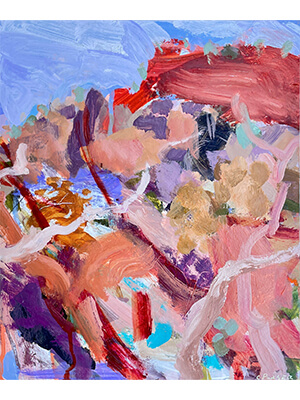
Expressive Floral Art with Sam Walton is a mixed-media workshop focusing on exploration and expression. You will learn techniques to create artworks using acrylic paint, collage, oil pastel, and everyday materials. Explore colour, line, texture, layering and abstraction to interpret flowers through your own unique visual language. Experiment with loose brushwork, expressive mark-making and unexpected combinations of materials to create vibrant, personal artworks that capture the mood and character of floral forms. This workshop will build your confidence to take creative risks, explore new approaches to art making with confidence and bring exploration and play into your art practice.
Sam's art is a joyful, abstract celebration of the natural world. She is endlessly inspired by the flowers and world around her, and her work is all about capturing the vibrant feeling of nature rather than painting a perfect picture of it. Sam loves to get her hands on a whole mix of materials, from acrylic paints to oil pastels and fine inks. Ultimately, she wants to show you the world through a different lens. Using reference images, Sam creates artworks that have both a piece of herself and her style and ode to the original image.
Students are required to bring some of their own materials for this workshop, including:
- Acrylic paints: a selection of colours, including white, black, warm and cool red, yellow and blue. Additional colours welcome
- Paintbrushes, small selection of round and flat brushes in assorted sizes
- Paper for painting and mixed media, A3 or similar heavy-weight paper suitable for acrylic paint and collage. Approx. 10-15 sheets
- Sketchbook or paper for initial studies, notes, experimentation and planning
- Drawing materials, graphite and colour pencils, eraser and sharpener
- Oil pastels, small set of assorted colours
- Black ink or drawing pens, waterproof fine liner or drawing pens, plus a black marker if desired
- Scissors
- Glue stick and or suitable paper adhesive for collage – modgpodge/ PVA/ medium
- Collage materials – old magazines, printed images, coloured paper, wrapping paper or other interesting papers you would like to incorporate into your artwork
- Palette
- Water container
- Apron or old clothing
- NB Miscellaneous materials, if there have been materials you have at home and have been wanting to try out or do something with, please bring them and we can look at how to use them through the exploration process
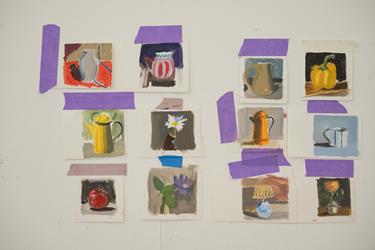
Discover the art of traditional still life painting in oils with artist Tarn McLean. Through observation and practical instruction, participants will learn the fundamental techniques of creating a still life painting, from arranging a composition and making an initial drawing to understanding tonal values, colour mixing, light and shadow. Tarn will guide students through the process of building a painting using traditional oil painting methods, with demonstrations and individual guidance throughout. Emphasis will be placed on developing observational skills, understanding form and confidently handling oil paint.
Tarn McLean is an Australian artist and designer whose practice explores painting, colour, composition and the relationship between art and the everyday. Holding a PhD in Visual Art from the University of Southern Queensland, Tarn works across traditional oil painting, contemporary abstraction, portraiture, still life and botanical subjects. Her work combines a strong understanding of traditional painting techniques with a contemporary approach to colour and form. Alongside her independent painting practice, Tarn is the founder of Ocre Designs, an artist-led design house. She brings a practical, encouraging approach to teaching, sharing her knowledge and enthusiasm for the art of painting.
Students are required to bring some of their own materials for this workshop, including:
- One stretched linen canvas, primed either clear or white. A size of approximately 50 x 60cm or 60 x 70cm is recommended; students wishing to work at a larger scale may bring a canvas up to a maximum of 70 x 90cm
- Artist quality oil paints
Preferred colours; Zinc white, burnt sienna, raw umber, cadmium yellow or yellow ochre, spectrum red or cadmium red, ultramarine blue.
Optional colours; magenta, paynes grey and any other colours if you have them - Good quality round brushes including 000, 00, 0, 1, 2 and larger if you have them in both round and flat\Pencil and eraser
- Ruler
- 100ml Linseed oil or stand oil
- Damar varnish
- Glass bottle with airtight lid 500ml
Clearly labelled: NO FOOD - Glass Jar with airtight lid 175g
Clearly labelled: NO FOOD - Palette
- Small bottle of baby oil