By Cameron Leckie, Regional Soil Coordinator
7 May 2026
Knowing your soil | benefits
With the cost and availability of key inputs into agricultural systems at front of mind, knowing your soil has arguably never been more important.
In February 2026, the Hub’s Regional Soil Coordinator, Cameron Leckie, along with Karyn McWhinney and Ashleigh Wassom (from the Queensland Government’s Graduate Soil Scientist program) visited Alice Moore at her property north of Casino NSW. The visit formed part of the prize from the SQNNSW Innovation Hub’s 2025 World Soil Day competition.
The visit included collecting soil samples at four sites for laboratory analysis as well as classifying the soil using the Australian Soil Classification. Combining soil classification along with soil chemical data provides much greater insights into both the condition of the soil and its capabilities than either chemical data or visual observation alone.
What did we find?
A lot of variability.
Across the four sites on Alice’s property, three distinctly different soil types were identified. They included Vertosols (soils high in clay that shrink when dry and swell when wet), a Kurosol (a soil with a marked increase in clay content with depth with a strongly acidic subsoil) and a Sodosol (where the clay subsoil is high in sodium).
Even the sites with the two Vertosols were quite different, largely because of the depth of soil. One of the sites had a nice deep soil (at least one metre) whilst the other was comparatively shallow, overlaying highly weathered sandstone. There was almost no Soil Organic Carbon (0.09%) in the bottom layer indicating that the effective rooting depth was only around 60cm at this site.
Soil laboratory analysis is helpful for identifying soil constraints such as acidity, alkalinity, salinity or dispersion which can limit productivity. Traditionally, Exchangeable Sodium Percentage (ESP, the amount of sodium relative to other cations such as calcium, magnesium and potassium), is used as a proxy for dispersion. Dispersion being a major constraint across large parts of Queensland and New South Wales that can result in hard compacted soils where roots can’t penetrate, and water infiltration is extremely slow.
At one of the sites (the Sodosol), the soil data highlighted that the soil was both sodic (ESP at nearly 12%) and magnesic (more magnesium than calcium is present). Typically based on these results, the application of gypsum (calcium sulfate) would be considered as an option to minimise the risk of, or address dispersion. However, a simple and free dispersion test identified that the soil did not disperse indicating that gypsum application was not required. A potentially handy cost saving.
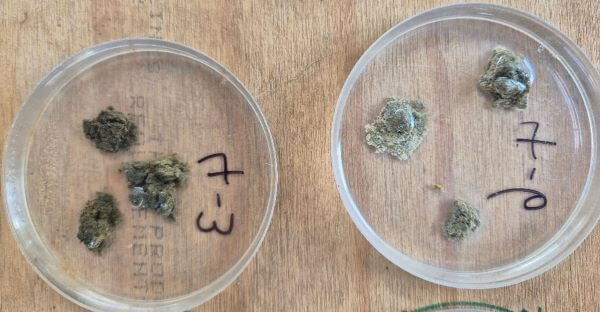
Despite being both sodic and magnesic, the aggregate stability test (dry soil aggregates placed into rainwater) demonstrated no signs of dispersion although there was some slaking. This photo was taken two hours after the soil aggregates were placed into the water.
The laboratory results included pH as measured in both water (pHw) and measured in a calcium chloride solution (pHCa). The two methods can provide quite different results as occurred at Site Two. Based on the pHw measurement alone it appeared that acidity was not a concern. However, the pHCa measurement indicated that the subsoil was strongly acidic and likely to be a negative influence on pasture productivity. This was further evidenced by the presence of appreciable exchangeable aluminium in the subsoil as well.
This example demonstrates how different soil tests can be identified to different aspects of soil condition and why understanding the nuances of soil test results is important.
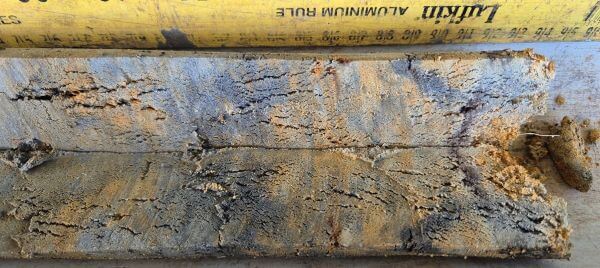
The strongly acidic subsoil from Site Two had some interesting colour patterns, referred to as mottling, which is an indicator of imperfect drainage (the soil is saturated periodically leading to changes in soil chemistry as highlighted by the colour patterns). One single fine root hair can be seen, an indicator that the subsoil acidity is restricting rooting depth.
Testing for carbon
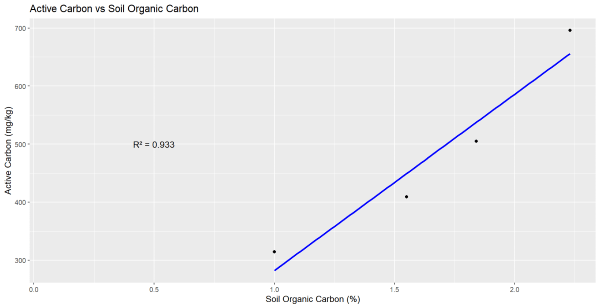
Active carbon, the most biologically active and rapidly turned over component of Soil Organic Carbon, was also measured for the topsoil (0-10 cm). Active carbon was found to be around 3% of the measured Soil Organic Carbon results across all four sites. What was interesting was the strong relationship, on an admittedly small dataset, between Active Carbon and Soil Organic Carbon. The two highest results were both from the Vertosol soils, which had a much higher proportion of clay compared to the loam topsoils for the Kurosol and Sodosol.
As was reported in a previous article, clay soils have a greater capacity to retain Soil Organic Matter than lighter textured soil which these results highlight.
Trials on the horizon
Alice found the entire exercise to be extremely fascinating and useful for understanding more about what types of soil she is dealing with.
In a small area, Alice noted they have quite a large amount of variation present, much more than she expected.
“Going forward (this) would potentially require vastly different management practices,” Alice said.
“The current land use is grazing, however, diversification opportunities may present themselves in the future and we are now so well equipped to address our soil constraints head on.
“In the short term, I will be implementing some small plot trials of improved pasture species and increased nutrition to understand what our soil responds to best.”

Equipped with an enhanced understanding of her soil, both across the property and with depth, Alice can now focus her efforts on building and maintaining a productive soil confident in the opportunities and limitations that the soil data and assessment have provided.
The Hub is busily planning for the 2026 World Soil Day competition. Watch this space.
Don't miss out
If you don’t want to miss news, analysis and our content sharing research to help you become more drought resilient and innovative, you should subscribe and follow!
- Subscribe to our monthly newsletter by clicking here
- Follow us on LinkedIn
- Follow us on Facebook
- Follow us on Instagram
The SQNNSW Innovation Hub Regional Soil Coordinator is supported by the Australian Government’s Natural Heritage Trust.
Published: 7 May 2026