By: Alex Ball (Rural Analytics) and Lu Hogan (Armidale Node)
26 March 2026
Faster herd recovery after drought: beef producers
Rebuilding a breeding herd after drought is one of the most financially painful phases a beef producer faces. Buy in females at peak prices or hold back additional heifers and wait years for numbers to recover; neither option is straightforward and both have significant cash flow implications. New on-ground demonstration trials from the SQNNSW Innovation Hub’s Armidale Node suggests a third path is now genuinely viable: modern artificial insemination technologies.
The Rapid Herd Recovery project, completed across four Angus properties in NSW in 2023 and 2024, tested what happens when three commercially available technologies are combined:
- genomic selection of replacement heifers,
- Fixed Time Artificial Insemination (FTAI), and
- frozen female sexed semen.
This project evaluated the potential impact of combining current and emerging technologies to accelerate breeding herd capacity through genomic selection, FTAI joining of heifers and increasing the female-to-male ratio of calves via the use of sexed semen. The goal: produce more female calves, with better genetics, faster.
What the trial demonstrated
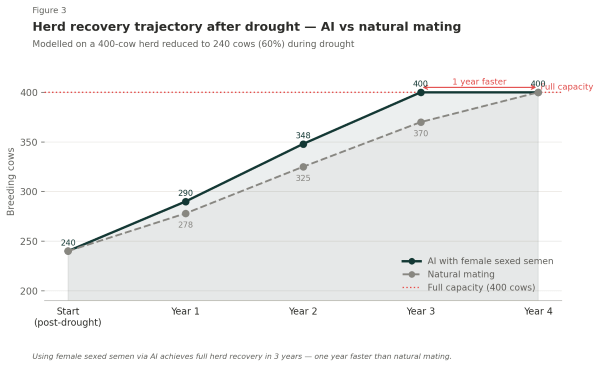
The headline finding is that using female sexed semen through FTAI can cut herd recovery time by a full year. Modelling based on a 400-cow herd reduced to 240 animals during drought showed recovery to original capacity in three years using AI with sexed semen, compared to four years under natural mating. In cash flow terms, that extra year matters enormously
The economics stack up, though not without conditions. Based on indicative prices for each of the components, an AI-produced heifer calf from female sexed semen costs around $269 to put on the ground, compared to $174 for a calf from natural mating (Bulls valued at $12,500), a difference of roughly $54 per head. However, when the genetics of those AI-bred heifers are factored in, the picture shifts. Using HeiferSELECT genomic profiling to identify and mate the highest-merit heifers to high merit AI sires, the on-ground project estimated a 2.8:1 return on that additional investment over an eight-year breeding lifetime. In practical terms, using AI sires in the top 5% relative to breed average is enough to recoup the cost difference.
There was also an unexpected bonus: all four property managers reported a reduction in dystocia (calving difficulty) in first-calf heifers carrying heifer calves. Early data from 2025-26 scanning suggests those heifers are also more likely to re-conceive in the subsequent joining, a compounding benefit that doesn't show up easily in the initial cost calculation.
What producers need to know
The trial did also raise some notes of caution. Conception rates from frozen female sexed semen were variable, ranging from 22% to 51% across properties and seasons, and a poor season appeared to compound the problem. Across all four well-managed herds, roughly one in five heifers joined remained empty, a result the researchers say warrants further investigation.
The practical takeaways are clear:
- work with experienced AI practitioners,
- use multiple AI bulls to reduce risk,
- focus on high merit semen,
- manage nutrition carefully before and after joining, and
- treat each AI program as something requiring active management rather than a set-and-forget approach.
Fresh sexed semen, now becoming commercially available, may deliver better conception rates and reduce the cost gap further.
For producers weighing up herd recovery options, this demonstration trial provides the most rigorous Australian evidence yet that combining genomic selection, FTAI, and female sexed semen is a commercially sound strategy, not just a research curiosity.
Keep reading
- Download the 2026 summary factsheet with the final results
- Read the final report (PDF)
- Watch the 2026 video sharing the final results
- Download the 2024 progress case study
- Watch the 2024 webinar on the initial results
The Rapid Herd Recovery project was hosted by the University of New England-hosted Armidale Node of the SQNNSW Innovation Hub, with support from NSW Local Land Services and Rural Aid, and funding from the Australian Government's Future Drought Fund.
Don't miss out
If you don’t want to miss news, analysis and our content sharing research to help you become more drought resilient and innovative, you should subscribe and follow!
- Subscribe to our monthly newsletter by clicking here
- Follow us on LinkedIn
- Follow us on Facebook
- Follow us on Instagram
Posted: 26 March, 2026. Updated 17 July 2026.