By Susan Webster
15 June 2026
Leveraging the invisible | carbon management
You need a rapid soil test of a paddock, but instead of looking at the ground in the future you could be looking to the skies and using science developed by SCU’s Dr Abe Gibson.
The soil scientist is helping develop remote soil sensing data using drones and satellites.
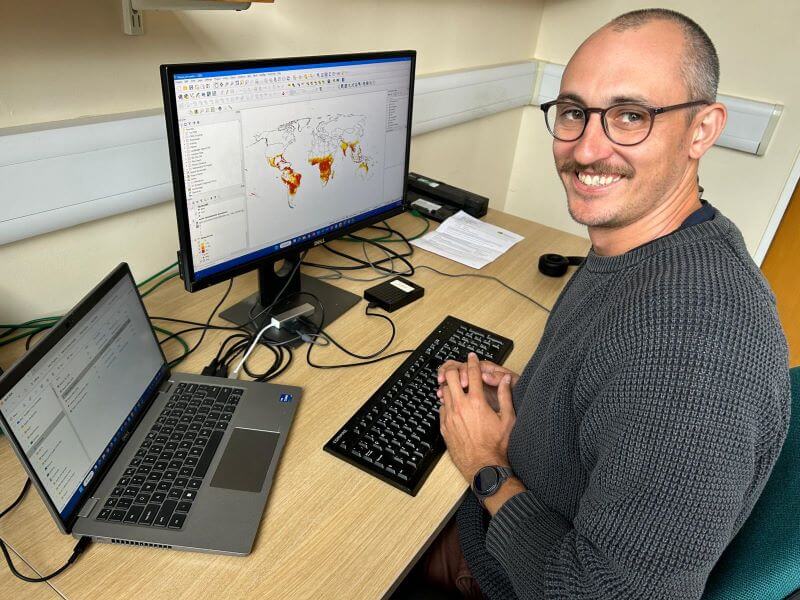
Dr Abe Gibson – from Lismore to Harpenden.
He is on a four-month special studies program at the UK’s esteemed agricultural R&D epicentre, the Rothamsted Institute, at Harpenden – about an hour north of London.
Working with Dr Stephan Haefele, he is working to the end of July 2026 to build data sets using GIS and remote sensing to map soil properties and their spatial variability.
He explains: “Energy from the sun hits the earth’s surface. A whole range of properties of that surface affects the amount of energy that gets reflected back into the atmosphere. And that’s what the satellite captures.
“For example, when manure gets added to cropping paddocks, that’s got a different spectral signature to soil without manure in it. My work is about being able to leverage the differences between the spectral signatures, which might not be within the visible spectra,” he said.
The work will have particular application to broadacre cropping. Dr Gibson’s initial focus is measuring soil carbon levels, coupled with clay and iron levels. “Those three go together to control long-term carbon storage,” he explained.
“We’re looking at how we can rapidly assess the potential for soil carbon storage. The implications for industry are to identify areas that could best-benefit from carbon management.”
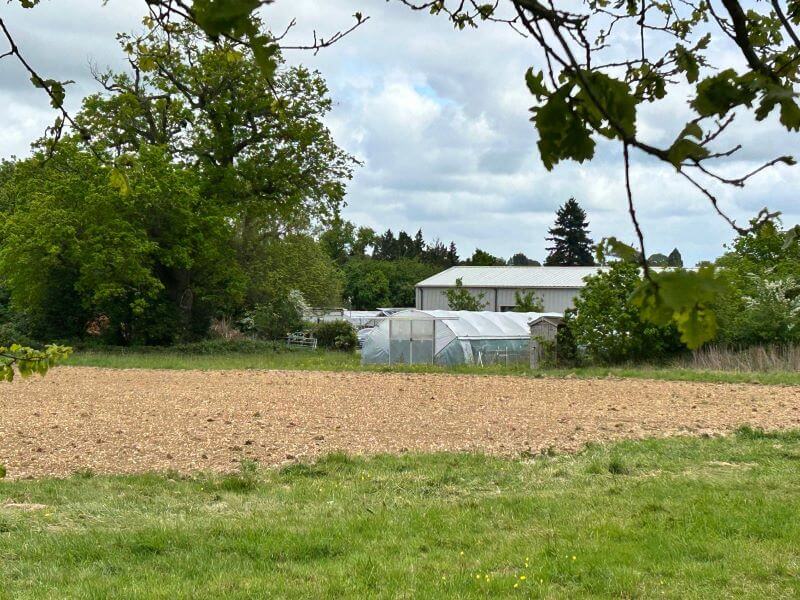
Rothamsted Institute, UK. 2026
Dr Gibson said lack of data is one of the biggest barriers for carbon-credit projects or even just empowering landholders to better-manage their soils.
“You take a soil test and you have to send it off to a lab; there’s the barriers of turnaround time as well as the cost of interpretation and the analyses.
“But these satellite products are out there and can happily integrate data for better soil management,” he said.
“The technology is definitely a cost and time saver. Although for something like a carbon project where the monitoring and validation is really strict, it’s probably never going to replace current methods. But as a rapid assessment tool where you need high-intensity sampling and to create efficiencies around that, I think is a really achievable goal.”
Will the work be transferable to Australian farming? “The pipeline that we come up with will be transferrable, but the responses will be different due to different environmental factors and will need optimising for those,” he said.
Does Dr Gibson’s work have any implications for drought mitigation and even drought resilience?
“It might be a bit optimistic but I definitely think so,” he said. “One of the issues around drought for Australia is data availability. We could develop this remote sensing platform and use that to assess soil and plant responses and link those collected data.”
He has found research priorities differ between the UK and Australia. “The drivers are a little bit different to the drivers of R&D in Australia,” he said. “GRDC (the Grains Research & Development Corporation) and MLA (Meat & Livestock Australia), they have their sustainability pillars in their strategic plans but here there’s a really big focus on sustainability in the UK, and the environmental drivers are totally different. UK farms are smaller, there’s smaller paddocks and water is a lot less limiting, so there’s more emphasis on things like biodiversity. And the farmers are responsible for a lot more on-farm auditing.
“Also, proximity to market, especially European markets, has an effect. They shape policy mechanisms around that sustainability drive. A lot of people talk about maintaining market access in Europe; you need to see it first-hand how that drives agriculture in R&D over here.”
Here is Rothamsted Research, the oldest continually operating agricultural research station in the world. It dates from 1843 when baronet Sir John Bennet Lawes, working with chemist Joseph Henry Gilbert, undertook farm trials on the family estate. The estate became the not-for-profit institute now operating to an annual budget of £32 million. The Lawes name is honoured in Queensland; Lawes being the site of the University of Queensland’s Gatton campus, which specialises in agriculture.
“The beauty of Rothamsted, for a soil scientist like me, are the long-running experiments,” said Dr Gibson. “It’s almost like an icon. I was doing my PhD in soil carbon and this is where so much soil carbon science is from.
“Being able to come here, to see how things are done, the development of ag trials here has inspired what we’re doing back home with our trials. So, it comes full circle, the whole reason for agreeing to do this project while coming over here – was to take these skills back and apply them.”
What has been his biggest eye opener? “The size,” he said. “I came from a small research group, so the first surprise was seeing how an organisation like this operates in terms of the scale of people.”
And the second surprise? “I was quite surprised that, when the sun finally comes out, how warm 15 degrees can actually be!”
This article is part of the SQNNSW Innovation Hub's Research for You series, highlighting relevant activities being carried out by national and international researchers, that have the potential to help Australian producers build their drought resilience.
Don't miss out
If you don’t want to miss news, analysis and our content sharing research to help you become more drought resilient and innovative, you should subscribe and follow!
- Subscribe to our monthly newsletter
- Follow us on LinkedIn
- Follow us on Facebook
- Follow us on Instagram
The SQNNSW Innovation Hub receives funding from the Australian Government’s Future Drought Fund.