By Cameron Leckie, Regional Soil Coordinator and Wim Linström, Partnership Broker (Stanthorpe)
29 July 2026
Healthy soils, resilient vines and tea bags
Can focusing on soil health form the basis of a successful vineyard?
For Twisted Gum Wines, located at Ballandean Queensland, this has proven to be the case. Owners Tim and Michelle Coelli have been practicing low input/regenerative viticulture for more than a decade. At the core of their approach to viticulture is focusing on soil health. As Michelle puts it, “it all starts with the soil”.
Tim and Michelle have implemented a range of practices to build soil health and eliminate the use of chemical fertilisers and pesticides. This includes a sward of perennial multi-species pastures in the mid-row between vines, grazing by a small flock of dorper sheep to enhance nutrient cycling, periodic additions of mulch under vines, and not cultivating the soil.
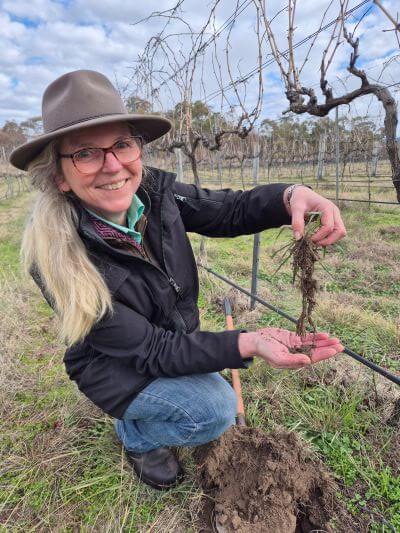
Michelle Coelli, looking very excited, at the healthy aggregation occurring around the rhizosphere from the perennial pasture sward that Twisted Gum has established.
Does the data support their observations?
The question that the Hub’s Wim Linstrom (Stanthorpe Partnership Broker) and Cameron Leckie (Regional Soil Coordinator) set out to answer was whether the data supports Tim and Michelle’s observations. This was achieved by conducting a comprehensive soil assessment at two sites at Twisted Gum Wines and one site at another local vineyard as a control, based on the EcoVineyards Best Practice Management Guide for soil health. Of note the case study was conducted during some of the driest conditions on record for the Granite Belt (2nd percentile rainfall!).
The results speak for themselves.
What did the tests show?
Both the sites at Twisted Gum Wines received higher scores on the soil health assessment than the control. Some of the key findings include:
- Measured Soil Organic Carbon (SOC) was substantially higher at Twisted Gum, both under vine and in the mid row, than the control. And not just by a little bit, being 1.2% higher under vine at Twisted Gum. The same trend was observed for Active Carbon.
- Higher Cation Exchange Capacity (CEC), a measure of a soils to hold onto nutrients such as calcium, magnesium and potassium at Twisted Gum. Because the soil at both vineyards is essentially sand (laboratory tests found no clay), the higher CEC values are a function of the higher levels of SOC.
- Nitrogen levels at Twisted Gum matched or exceeded those in the fertilised conventional vineyard despite no synthetic fertiliser use.
Tea bags?
A novel component of the case study was the determination of the ‘Tea Bag Index’ (TBI) including a comparison to nearby native vegetation at Twisted Gum. The TBI involves burying two types of tea (green and rooibos) for several months from which both the decomposition rate and degree of stabilisation of organic matter can be determined. The results indicated that the Twisted Gum Wines management system supports both active organic matter processing and efficient carbon stabilisation.
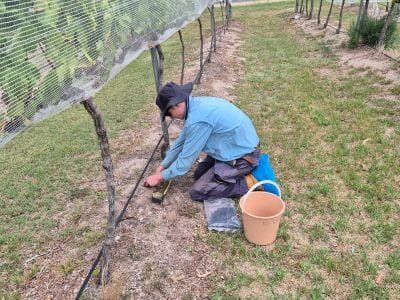
UniSQ student Arthur Ridgeway (who is being supervised by the Regional Soil Coordinator as part of a Work Integrated Learning unit) burying tea bags as part of the ‘Tea Bag Index’ experiment.
From a soil physical health perspective, the soil at Twisted Gum Wines had functionally deeper topsoil, lower bulk density, higher porosity and improved soil structure compared to the control.
Whilst these results are encouraging, ultimately it is the productivity of the vines and the quality of the grapes that counts.
Long term Normalised Difference Vegetation Index (NDVI – basically a measure of photosynthesis) results were similar or better at Twisted Gum Wines. Reliable yield data is not available for Granite Belt vineyards; however, it appears that Twisted Gum Wines production is comparable to other vineyards in the area. Twisted Gum Wines has also received several awards for its wines, an indicator of grape quality.
Combined, this indicates that the focus on soil health has not come at the cost of either productivity or quality.
This is particularly important given the increasing challenges posed by variable seasonal conditions and rising input costs. Improved soil functionality provides a buffer against climatic extremes whilst reduced input dependency reduces ongoing risks to supply chain disruptions. Together, these findings highlight a practical pathway for growers to improve soil function, reduce input dependency and build resilience while maintaining productive vineyard businesses.
Want more?
Growers interested in improving soil health in vineyards can explore:- The EcoVineyards Best practice management guides including soil health and ground covers.
- Assessing soil quality and interpreting soil test results in viticulture systems.
- Soil Science Australia’s Resource Library for general soil information.
For more detail, read the full case study: click here to download (1.4MB PDF)
Don't miss out
If you don’t want to miss news, analysis and our content sharing research to help you become more drought resilient and innovative, you should subscribe and follow!
- Subscribe to our monthly newsletter
- Follow us on LinkedIn
- Follow us on Facebook
- Follow us on Instagram
The SQNNSW Innovation Hub receives funding from the Australian Government’s Future Drought Fund, and the SQNNSW Innovation Hub Regional Soil Coordinator is supported by the Australian Government’s Natural Heritage Trust.
Published: 29 July, 2026