Governance as currency: trust, capability, and AI
2 min read
20 Feb 2026
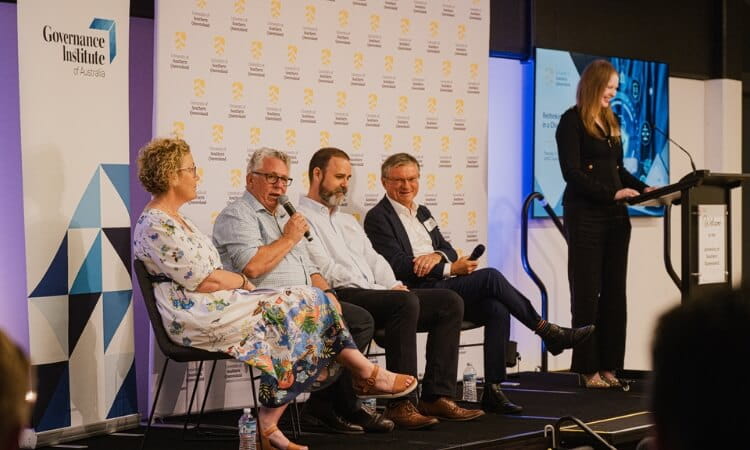
The first UniSQ Thought Leadership Series event of 2026, held at its Toowoomba campus, brought regional and cross-sector leaders together to examine how governance must adapt to remain effective and trusted.
Delivered in partnership with the Governance Institute of Australia, Rethinking Governance in a Changing World featured insights from Julia Spicer OAM, Sean Johnson, Bruce Cowley, and Dr Aaron Timoshanko. The discussion was expertly moderated by UniSQ’s Dr Jasmine Thomas.
The conversation moved well beyond compliance, centring governance as a source of strategic clarity, organisational resilience and, ultimately, trust.
Panellists confirmed that while connectivity can present challenges regionally, capability is not lacking.
Trust emerged as the core currency of governance. Without it, strategy fragments and risk increase. Building governance capability was framed as a form of capital – strengthening institutional resilience.
Practical issues were addressed directly: managing conflicts of interest with transparency and embedding robust succession planning.
Artificial intelligence was a key theme of the future-focused discussion. The panel was unequivocal: ignoring AI is not an option. AI was compared to the early internet – once optional, now essential infrastructure. Leaders were encouraged to build familiarity through training and experimentation rather than retreating from uncertainty.
At the same time, transparency and accountability in AI use were emphasised. Safeguards, testing protocols, and technical expertise must accompany adoption. Clear lines of responsibility must remain in place when decisions are informed by AI.
Looking ahead, the emergence of agentic AI – systems capable of autonomous action – was identified as a significant governance horizon requiring stronger oversight, clearer risk management, and deeper technical literacy.
Audience questions reinforced that diversity and skills depth remain critical considerations. The discussion emphasised the need for rigorous skills matrices and genuine gap analysis to ensure governing bodies reflect the expertise required for increasingly complex operating environments.
The evening reinforced that governance is not static. It must evolve with economic pressures, workforce shifts, and technological disruption. But its foundation remains constant: clarity of purpose, disciplined process, diverse capability, and the preservation of trust.
The full event recording is now available to watch.
Related news

6 min read
19 Oct 2026
2 min read
16 Oct 2026

4 min read
15 Oct 2026