By Cameron Leckie, Regional Soil Coordinator
5 December 2025
Down in the dirt | World Soil Day 2025
I’m a firm believer that we should celebrate soil every day, but today (5 December) is the globally recognised World Soil Day, committed to raising global awareness about the role soils play in agricultural development, ecosystem functions and food security.
According to the Food and Agriculture Organization of the United Nations:
- 95% of our food comes from soils
- 33% of soils are degraded
- it can take up to 1 000 years to produce just 2-3 cm of soil
- up to 58% more food could be produced through sustainable soil management
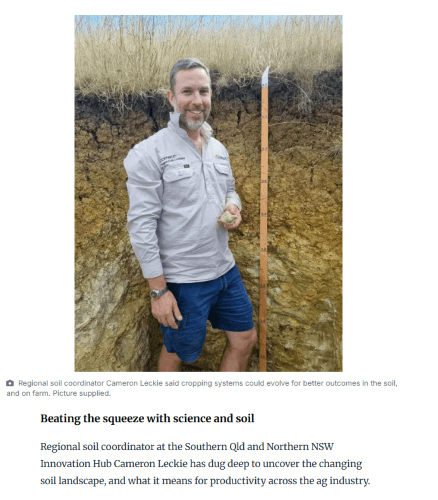
I was recently interviewed by Eliza Spencer for The Land about how cropping systems can evolve for better outcomes in the soil and on-farm in a warming climate.
Warming soils increase the activity of soil microbiology, chewing up inputs for crops and leaving less organic matter in the soil. Organic matter which is our best defence to combat erosion and run-off across our agricultural landscapes.
As I say in the article, that means the buffering capacity of soil becomes less resilient because it has less organic matter, and it is organic matter which helps keep the soil resilient. Less organic matter means you lose soil structure, which leads to slower infiltration rates and more runoff, which cycles back to increased erosion and lower fertility.
Soil science and the back pocket: farmer doubles capacity with perennial pastures
We then need to have more inputs to maintain productivity; you're more susceptible to diseases, and the soil is less robust.
To maintain production with soil conditions going in the wrong direction, will require greater inputs. The less resilient your soil is, the more you need to do to manage that … it just gets harder and harder to maintain productivity.
That's where the squeeze will come. We're trying to maximise and sustain our productivity, but at the same time, it's getting more and more difficult.
I’ve noticed many landholders have already turned their soil health around, utilising diverse pastures and crops, and keeping them in the soil for longer, to store carbon, increase organic matter, and restore erosion hotspots.
The philosophical and practical challenge for farmers is tackling the fallow. Cropping systems in Queensland and parts of New South Wales are based on the fallow but we know fallows aren't particularly efficient in storing water.
For the future, there’s a need for more exploration of how we incorporate cover crops to maintain the diversity, keep the plants growing, keep the biology fed, and also make cropping country rain ready, to reduce losses to run-off and evaporation.
The SQNNSW Innovation Hub Regional Soil Coordinator is supported by the Australian Government’s Natural Heritage Trust.
The SQNNSW Innovation Hub receives funding from the Australian Government’s Future Drought Fund.
Cameron Leckie is the Regional Soil Coordinator for Southern Queensland and Northern NSW. He is an accredited Registered Soil Practitioner, an Agricultural Engineer, and nearing completion of a PhD in soil science investigating the spatial variation of soil constraints and infiltration. You can email Cameron for more information.